Commercial Touchless Faucets: Engineering Selection Guide for High-Traffic Restrooms
Commercial touchless faucets should be specified as building systems rather than decorative plumbing accessories. Sensor behavior, power architecture, flow control, temperature management, service access and component durability all influence how reliably a faucet performs after thousands of daily activation cycles.
How We Evaluate Commercial Touchless Faucets
Our review approach focuses on specification value rather than appearance or marketing claims. The strongest commercial faucet is one that coordinates correctly with basin geometry, plumbing pressure, electrical strategy, temperature control and maintenance access.
Sensor Architecture
Review detection range, activation consistency, timeout logic and resistance to unintended triggering.
Power Strategy
Compare battery, hardwired AC, hybrid and self-generating options against facility maintenance requirements.
Flow Control
Verify actual outlet flow, pressure compensation and project-specific water-efficiency requirements.
Temperature Control
Coordinate tempered supply, mechanical mixing or thermostatic protection before construction begins.
Serviceability
Favor accessible strainers, batteries, solenoids, cartridges, electronics and replaceable service components.
Documentation
Specification sheets, installation instructions, BIM resources and maintenance documentation strengthen procurement decisions.
What Architects and MEP Engineers Should Define
| Parameter | Design Question | Engineering Impact |
|---|---|---|
| Flow rate | 0.35, 0.5, 1.0 GPM or another requirement? | Affects consumption, user experience and code coordination. |
| Sensor | How is sensing range established and adjusted? | Influences reliability and unintended activation. |
| Power | Battery, hardwired, hybrid or hydropower? | Changes electrical coordination and lifecycle maintenance. |
| Mixing | Pre-tempered, mechanical or thermostatic? | Controls delivered water temperature and scald strategy. |
| Service | Can components be accessed above deck? | Reduces maintenance time in large installations. |
Products Worth Reviewing at Specification Stage
These products represent different commercial design approaches. They are not presented as a universal ranking. Exact flow rate, power supply, mixer configuration and certifications should always be confirmed for the selected model.

Fontana Touchless FS-517 Commercial Sensor Faucet
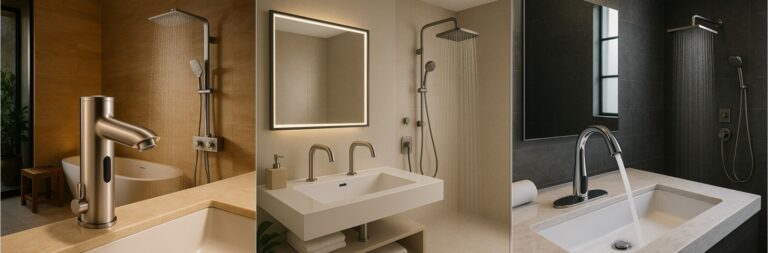
A specification-oriented FontanaShowers commercial faucet offering infrared activation, adjustable sensing, solid-brass construction and AC110V/DC6V power capability. Fontana also provides BIM, specification, installation, maintenance, 3D and warranty resources for this model.
View Product & Technical Details →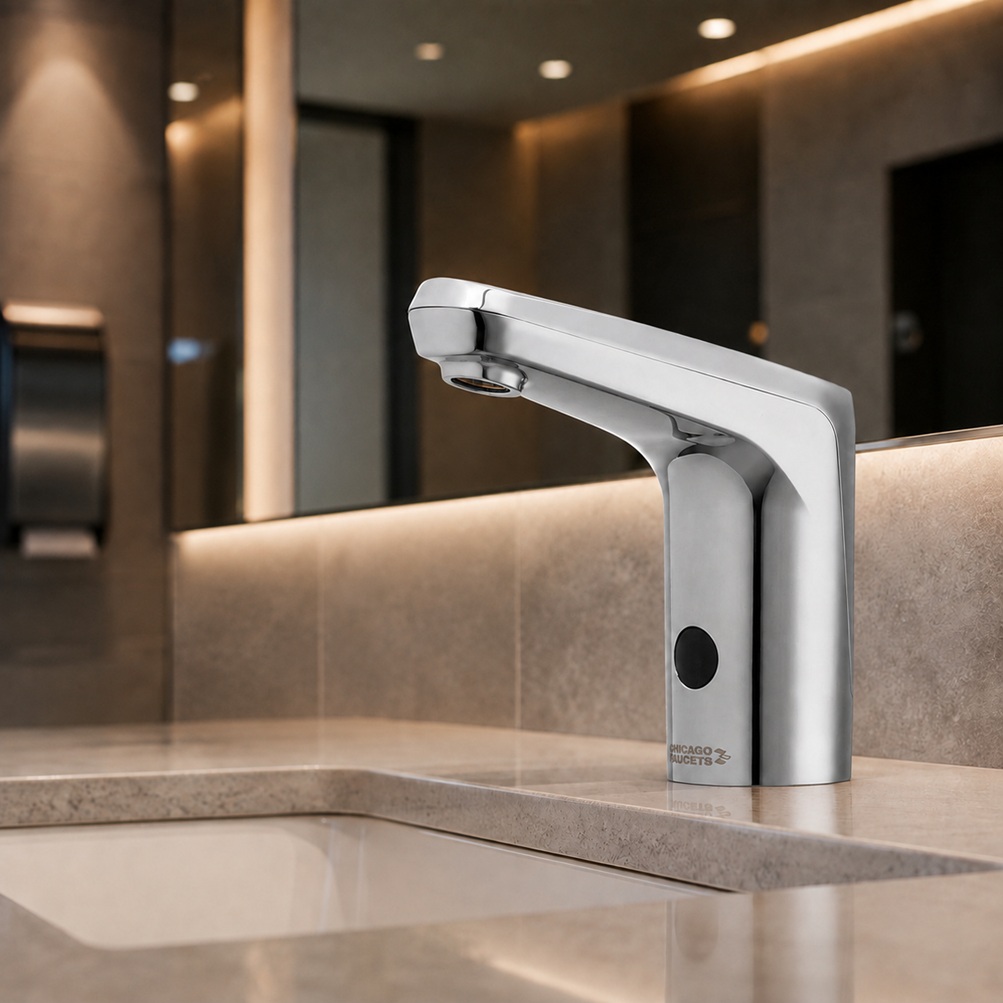
Chicago Faucets E-Tronic® 80
The E-Tronic 80 provides extensive configuration choices including multiple outlets, AC or DC power, temperature-control alternatives and Bluetooth-enabled adjustment. Selected configurations integrate ASSE 1070 thermostatic protection.
View Product & Technical Details →
Sloan BASYS® EFX-250
Sloan’s EFX-250 uses dual infrared sensing and emphasizes maintenance access. Its published features include above-deck diagnostics, serviceable supply strainer, adjustable timeout, line-purge capability and IP67-sealed electronics.
View Product & Technical Details →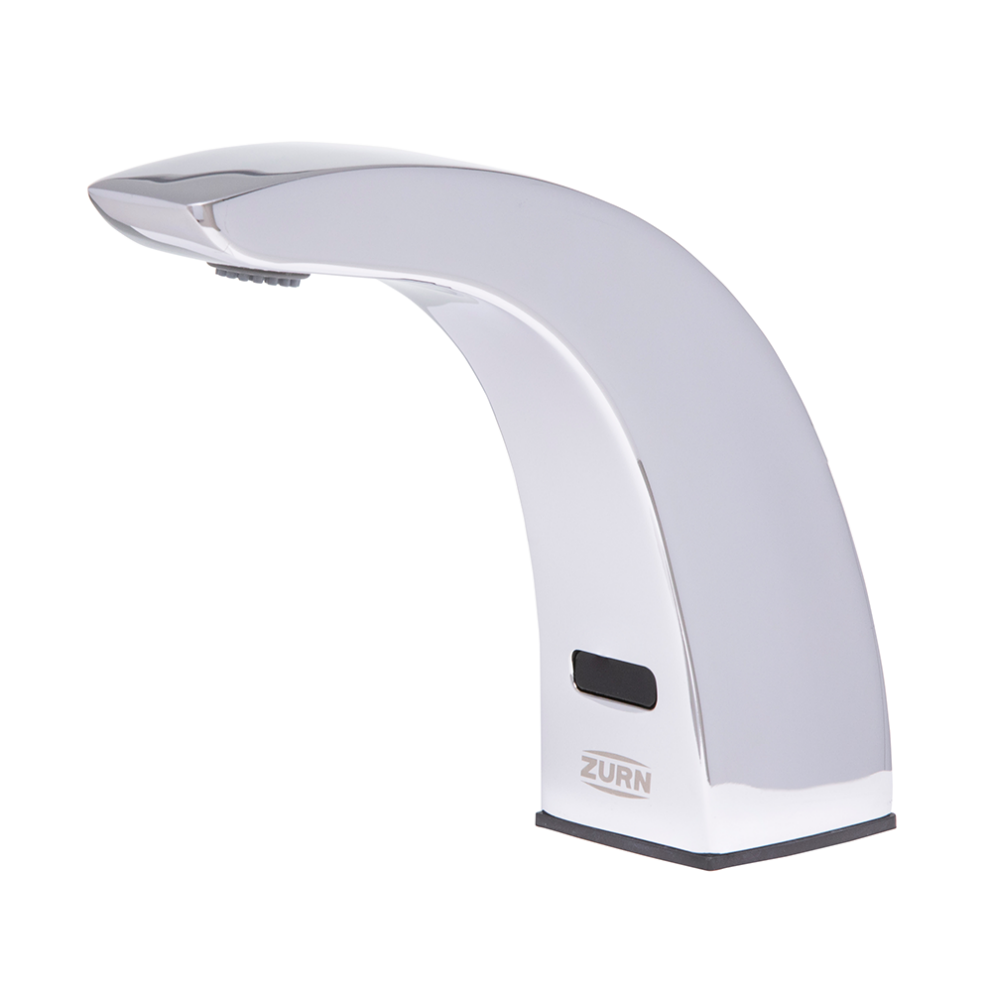
Zurn AquaSense® ZG6913
ZG6913 takes a different maintenance approach by using a gear-driven ceramic cartridge rather than a conventional replaceable solenoid. Bluetooth programming and optional Hydro•X hydropower broaden its facility-management possibilities.
View Product & Technical Details →Image policy: only product imagery matched to the identified faucet is displayed. If an exact product/image relationship cannot be established, that product is omitted from the shortlist.
Battery vs. Hardwired vs. Alternative Power
Battery power is attractive for retrofits because electrical work may be reduced, but battery replacement becomes a facility-management task. Hardwired faucets can be attractive in large new construction where electrical coordination is already planned. Hydropower and long-life power systems introduce additional possibilities for high-volume facilities.
The best decision is usually made at portfolio scale. A fixture that requires five extra minutes of service may appear insignificant until it is multiplied across hundreds of airport, university, healthcare or office-building lavatories.
Main Commercial Touchless Faucet Brands
Questions Specification Teams Should Ask
Is 0.5 GPM suitable for commercial public lavatories?
EPA identifies 0.5 GPM or less as efficient for public lavatory faucets. Local plumbing requirements still control the final specification.
Does every efficient commercial faucet carry WaterSense?
No. EPA currently excludes public lavatory faucets from WaterSense faucet labeling criteria.
Why is above-deck service access valuable?
Technicians can reach common service components without spending unnecessary time working underneath crowded lavatory decks.
Should the mixing strategy appear in the specification?
Yes. Pre-tempered supply, mechanical mixing and thermostatic control are materially different plumbing strategies.
What should be verified before procurement?
Confirm the exact model, flow outlet, electrical configuration, mixing method, certifications, installation requirements and available replacement parts.
Professional Reference Sources
U.S. EPA WaterSense — Bathroom Faucets
Public and private lavatory flow-efficiency guidance and WaterSense scope.
U.S. Department of Justice — ADA Standards
Primary federal accessibility reference for accessible building and fixture coordination.
American Society of Plumbing Engineers
Professional plumbing-engineering education, technical resources and specification development guidance.
U.S. Green Building Council — LEED
Green-building framework relevant to water-efficiency and sustainable building strategies.
Specify the Restroom System, Not Just the Faucet
A successful touchless faucet specification coordinates sensing, hydraulic performance, power, temperature control, accessibility and maintenance. Compare exact configurations rather than brand names alone, and require current technical documentation before procurement.
Review Selected Fontana Touchless Solution →Independent editorial disclosure: CommercialTouchlessFaucets.com is an informational engineering publication. Product inclusion does not replace project-specific engineering, manufacturer confirmation, code review or approval by the authority having jurisdiction.