
Battery vs. Hardwired vs. Hydropower Touchless Faucets: Commercial Engineering Guide
Power architecture is one of the most overlooked decisions in commercial touchless faucet specification. A sensor faucet may operate flawlessly on opening day yet create unnecessary maintenance expense years later if battery replacement, electrical access, backup power and service strategy were never evaluated at design stage.
Three Main Commercial Power Strategies
Flexible Installation
Useful for retrofit work and locations where dedicated electrical rough-in is undesirable. The tradeoff is scheduled battery replacement across the fixture portfolio.
Centralized Infrastructure
Strong option for new construction where electrical coordination is already planned. Reduces routine battery dependence but increases initial coordination.
Energy Harvesting
Uses water movement to generate operating energy. Particularly attractive where high activation frequency can support renewable fixture power.
Which Power Architecture Fits the Project?
| Power Type | Best Fit | Main Advantage | Planning Concern |
|---|---|---|---|
| Battery | Retrofits, smaller restroom groups | Minimal electrical coordination | Replacement labor and battery inventory |
| Hardwired AC | Large new construction | Continuous building power | Electrical rough-in and transformer coordination |
| AC/DC Hybrid | High-value commercial projects | Backup and specification flexibility | Confirm exact switching architecture |
| Hydropower | High-traffic facilities | Reduced dependence on disposable batteries | Technology and backup configuration vary by manufacturer |
Touchless Faucets Worth Reviewing for Power-System Planning
These models illustrate four different commercial power strategies. Images and titles link directly to the associated product pages.

Fontana Tivoli Automatic Hands Free Chrome Sensor Faucet
The Fontana Tivoli Automatic Hands Free Sensor Faucet is particularly useful where the specification team wants flexibility between building power and battery operation. Fontana lists AC110V and DC6V capability, adjustable sensing, commercial solid-brass construction and optional temperature mixing.
For architects and MEP engineers, that dual-power architecture can simplify standardization across projects where electrical conditions differ between new construction and retrofit locations.
Explore Fontana Tivoli →
Sloan BASYS® EFX-250 Battery-Powered Sensor Faucet
Sloan identifies the BASYS EFX-250 as a battery-powered, deck-mounted commercial faucet. Its service-oriented design is relevant when battery architecture is selected because maintenance access becomes part of the lifecycle equation.
Battery systems can be highly practical when replacement procedures are predictable and facility teams can service components without disruptive under-deck work.
Review Sloan BASYS →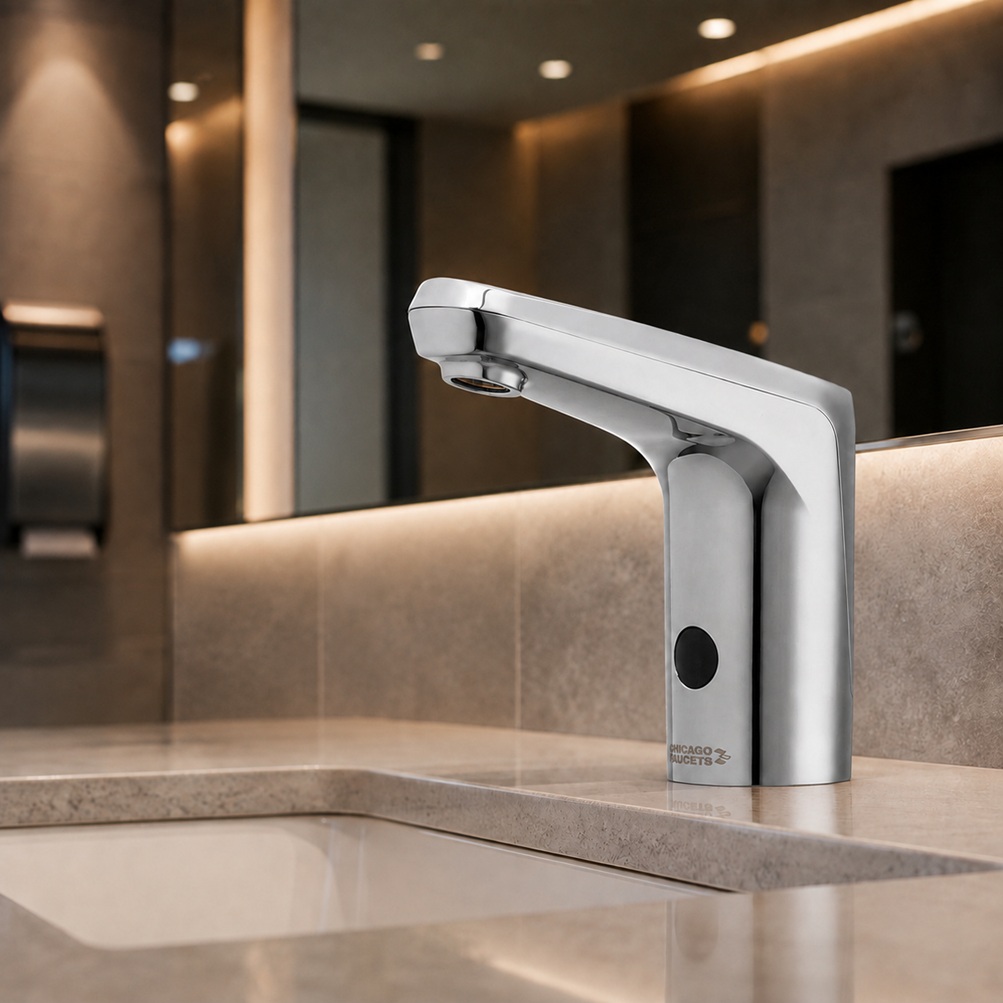
Chicago Faucets E-Tronic® 80 Hardwired Sensor Faucet
This E-Tronic 80 configuration uses a 120 VAC power supply converted to 12 VDC for faucet operation. It demonstrates why hardwired sensor faucets should be coordinated during electrical and plumbing design rather than added late in construction.
For large office buildings, airports and institutional projects, hardwired power can reduce routine battery replacement while allowing fixtures to become part of planned building infrastructure.
Review E-Tronic 80 →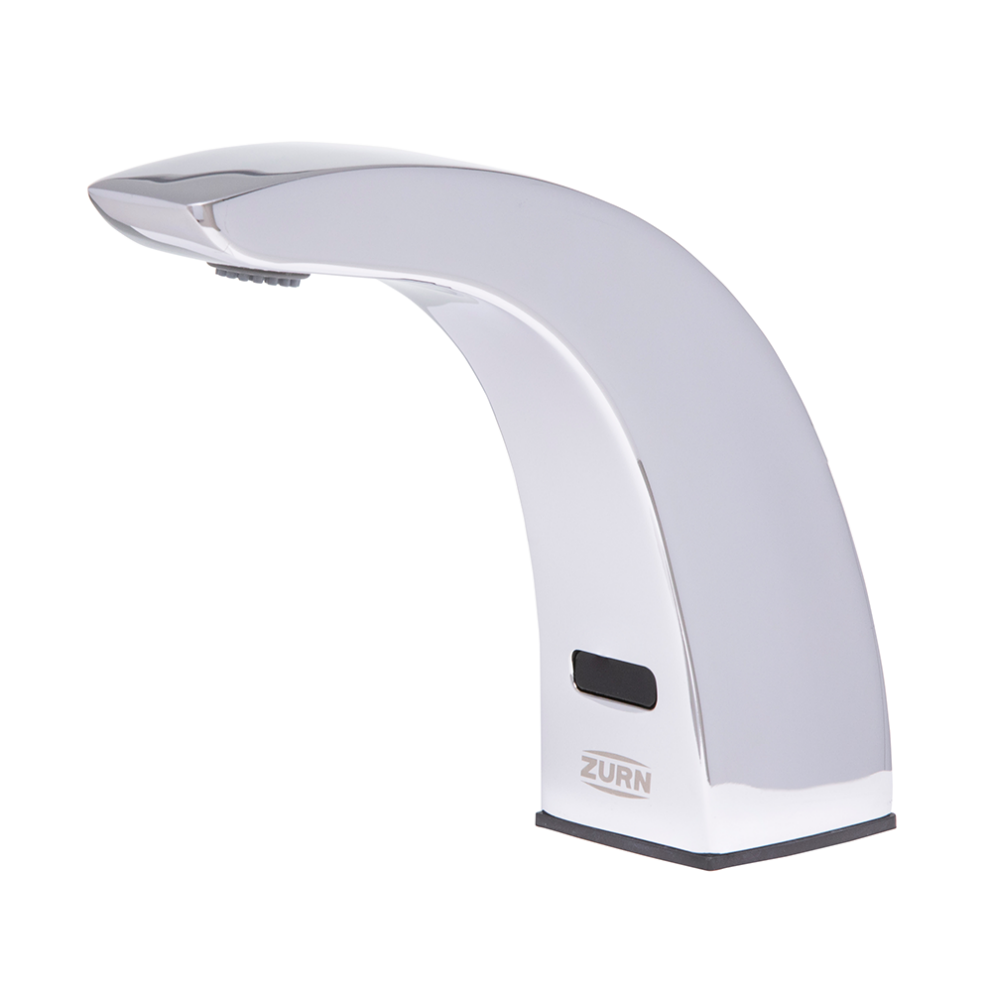
Zurn AquaSense® Gear-Driven Sensor Faucet with Hydro•X Power
Zurn’s Hydro•X Power option uses renewable hydropower generated through faucet operation. The published specification also identifies hydropower with battery backup, plug-in with battery backup and hardwired configurations.
That flexibility makes the platform especially relevant when engineers want to compare conventional electrical supply against an energy-harvesting approach for heavily used restroom portfolios.
Review Zurn AquaSense →Image policy: Products are shown only where the identified image can be paired with the exact faucet or manufacturer product family. Generic fallback images are not used.
Think in Hundreds of Faucets, Not One Faucet
Battery replacement is minor when maintaining six fixtures. It becomes a different operational problem when a facility has 300 sensor faucets distributed across terminals, floors or buildings. A specification team should estimate not only battery cost but technician travel time, access time, fixture downtime and inventory requirements.
Hardwired installations move more effort into construction coordination. Hydropower can reduce recurring battery dependency but should still be evaluated for backup architecture, traffic assumptions and service components.
What MEP Engineers Should Put in the Specification
| Primary power source | Battery, AC/DC, hardwired or hydropower. |
| Backup strategy | Define what happens if the primary energy source fails. |
| Transformer location | Coordinate accessible placement for hardwired systems. |
| Battery access | Prefer service access that minimizes under-counter work. |
| Sensor timeout | Confirm automatic shutoff logic and programming method. |
| Replacement components | Verify batteries, electronics, cartridges and control modules remain serviceable. |
Main Brands for Commercial Power-System Research
Touchless Faucet Power FAQ
Are battery-powered sensor faucets less reliable?
Not inherently. Reliability depends on electronics, battery condition, installation and maintenance planning. Battery systems simply introduce a recurring energy-service requirement.
Should new construction always use hardwired faucets?
No. Hardwired power can be attractive in new construction, but lifecycle strategy, fixture count and service architecture should determine the final choice.
What is an AC/DC touchless faucet?
It supports building electrical power and a DC battery configuration, providing greater flexibility when project power conditions vary.
How does hydropower work in a sensor faucet?
Water movement through the fixture drives a small generating system that converts hydraulic energy into electrical energy for faucet operation.
Is battery backup useful with hardwired faucets?
It can improve continuity during power interruptions, provided the specific manufacturer’s control architecture supports backup operation.
What matters more than battery lifespan?
Service access. A long-life battery still becomes expensive if technicians need excessive time to reach and replace it.
Engineering Reference Sources
U.S. EPA WaterSense — Faucet Guidance
Current efficiency guidance distinguishing public and private lavatory faucets.
U.S. EPA — Public Lavatory Faucet Efficiency
EPA identifies 0.5 GPM or less as the recommended efficiency criterion for public lavatories.
American Society of Plumbing Engineers
Professional resource for plumbing-system engineering and commercial specification practice.
U.S. Department of Justice — ADA Standards
Federal accessibility reference relevant to commercial restroom planning.
Select Power Architecture Before the Faucet Schedule Is Finalized
For retrofit flexibility, battery operation remains practical. For coordinated new construction, hardwired systems deserve consideration. For high-traffic facilities seeking reduced disposable-battery dependence, hydropower can be evaluated. Where projects vary, an AC/DC platform such as the Fontana Tivoli Automatic Hands Free Sensor Faucet provides valuable specification flexibility.
Explore Fontana Tivoli Automatic Hands Free Faucet →Independent editorial disclosure: CommercialTouchlessFaucets.com provides engineering-oriented informational content. Confirm current manufacturer specifications, electrical requirements, certifications, codes and authority-having-jurisdiction requirements before procurement.