
Hygiene • Water Conservation • Performance • Compliance
In the rapidly evolving world of commercial restroom technology, the trends discussed in this article continue to grow in importance as facilities prioritize hygiene, efficiency, and sustainability. New developments in sensor accuracy, water-use optimization, and smart building integration have emerged over the past year, reinforcing why businesses and design professionals should stay informed about the latest innovations in touchless faucet systems. This update reflects ongoing industry interest and confirms that the content below reflects current best practices as of 2026, making it a more valuable and up-to-date resource for planners, engineers, and facility managers. The plumbing requirements for restroom fixtures in commercial and institutional facilities have evolved from conventional lever and knob-operated plumbing to complete plumbing systems controlled by sensors. The touch faucet has emerged as the cornerstone of efforts to optimize hygiene, conserve water, and meet plumbing requirements in high-density applications such as airports, hospitals, collegiate institutions, and government organizations. When evaluating restroom fixtures, design professionals must consider longevity, sustainability, and performance on all counts.
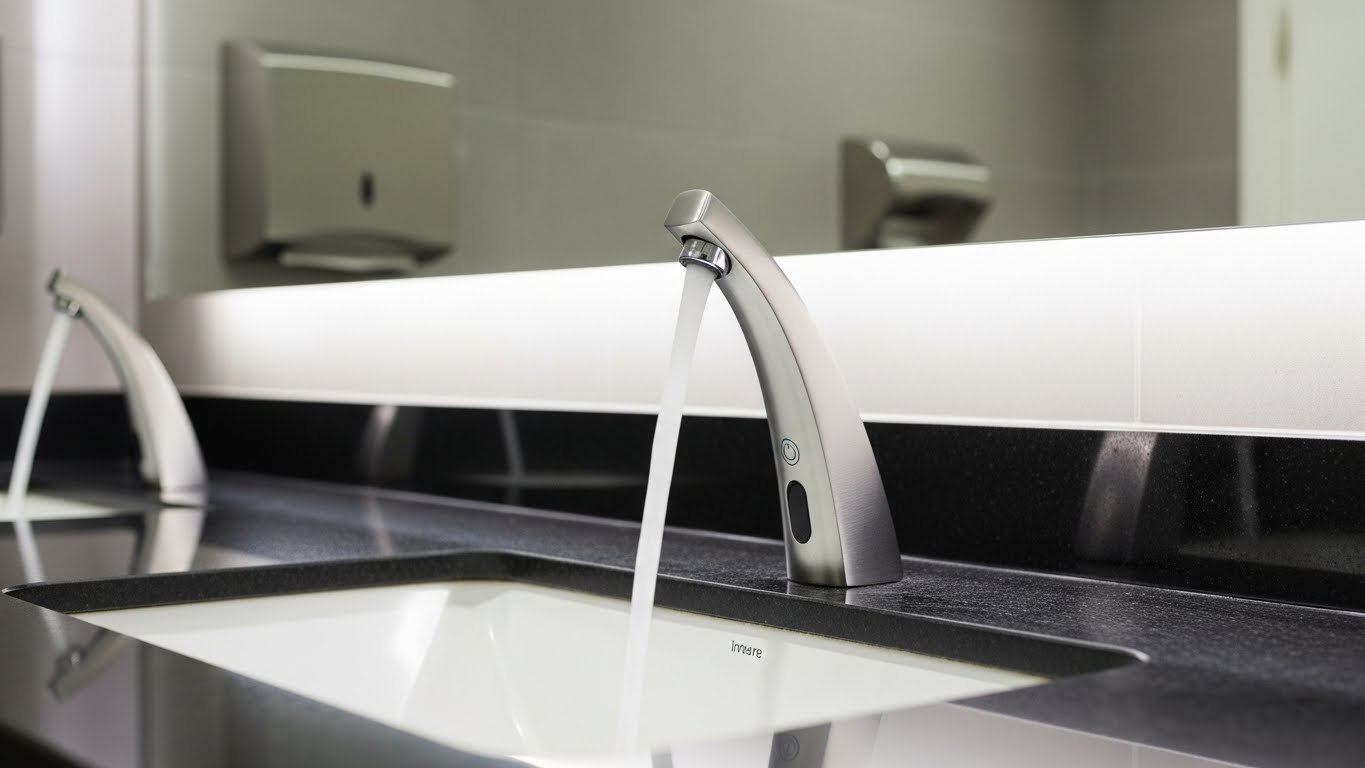
The Need for Touchless Faucets in Contemporary Toilet Designs
Touchless faucets are also popularly known as automatic or sensor-controlled faucets. Such faucets make use of proximity or time-of-flight sensing. Such types of faucets are useful for turning on the flow of water only if it is needed. As per the standard conventions used in the industry, such types of faucets are the ones where presence sensing along with the control of valves happens in an automatic way. This, in turn, leads to minimized spread of germs as well as wastage. For more details, see the source links below.
Speaking from a building design and engineering perspective, touch technology is a much, much bigger concept with regard to building performance factors, aside from simply clean hands, including, for instance, health, sustainability, and efficiency.
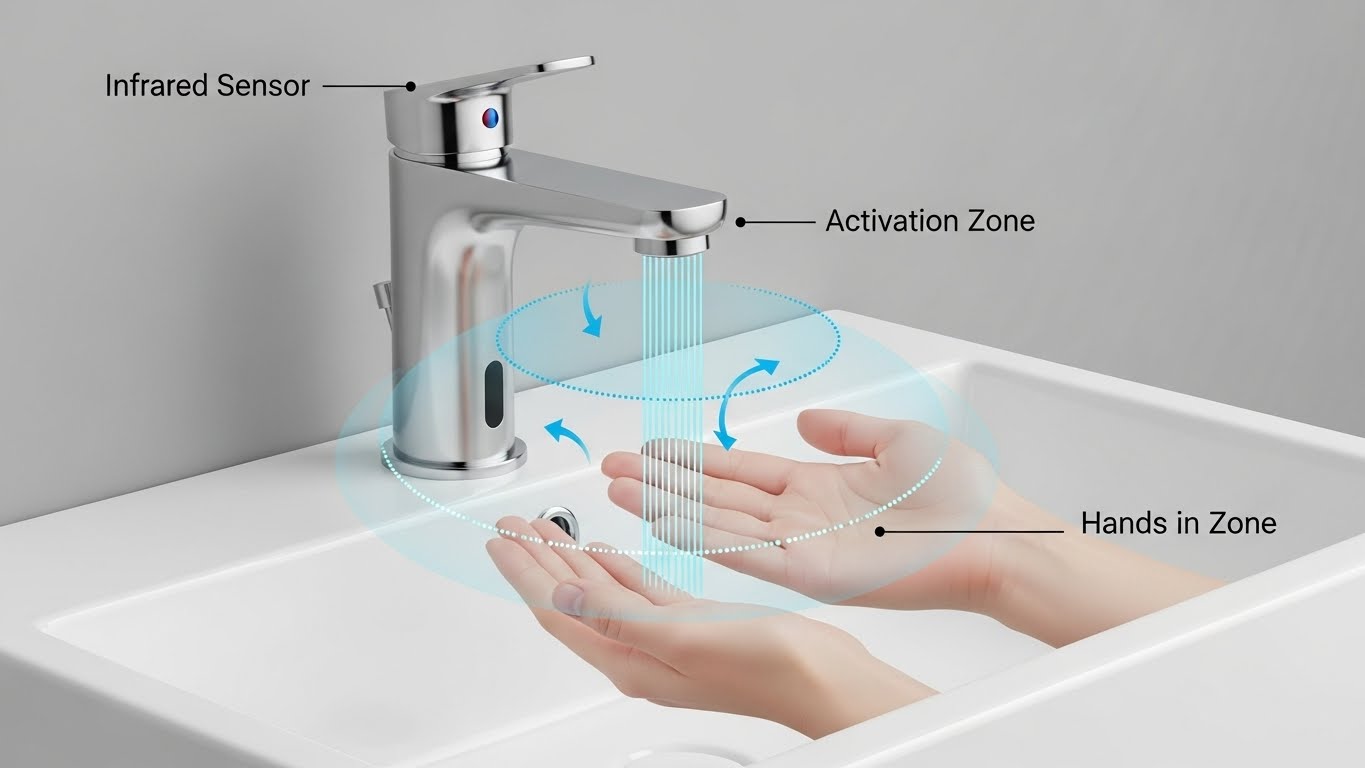
Engineering Principles That Underlie Touchless Technology
Sensor Technologies
Present day commercial sensor faucets incorporate several sensor technologies:
IR Proximity Sensors – These rely upon the variation in the IR rays to trigger the action of the valve opening. IR sensors tend to be disturbed by other light sources if not positioned well.
Time-of-Flight (ToF) Sensors – How ToF sensors work is by calculating how long it takes for the vicinity of near-infrared light emitted by the sensor to reflect back from the hand or object. These sensors work better when it comes to measuring distances within a bathroom setting regarding removing false activation from basin geometry and reflections. Information about this technology can be found in the source links below.
In relation to the engineering specification, the algorithms of the sensors have to focus more on adaptive calibration and signal processing, capable of damping transient activation while also ensuring the registration of intended use.
Hydraulic and Solenoid Valves Design
Touchless faucets use a solenoid valve, which is controlled by the microcontroller unit, or MCU, for the regulation of the water flow. The requirement for the solenoid valve is that it should provide an absolute mechanical seal, withstand millions of cycles, and completely match the pressure-compensating flow regulators. This is necessary for the application of the specified flow rates, which are required by the standards ASME A112.18.1/CSA B125.1. The performance of the water usage and the pressure of the supply, for instance, the pressure of 20-80 psi, should be demonstrated by standardized tests required by the standards of plumbing. For more details, see the source links below.
Coordination of Power and Electronics
In commercial toilet designs, there are three types of power methods:
Battery Powered: It enables easy deployment and availability but comes with maintenance planning to address battery life and accessibility.
Low Voltage DC or Hardwired:
It provides a strong power supply, making it simple to integrate it with the Building Automation System.
Energy Harvesting: Research and Development activity focused on exploring advancements for harvesting energy from the kinetic energy of water to minimize reliance on batteries and thus reduce servicing.
Electronic circuits must be resilient against electromagnetic interference (EMI) as well as surge protection in order to operate efficiently in an electrical environment.
Accordance with Regulatory Requirements and Performance
ADA Accessibility
Americans With Disabilities Act Accessibility Guidelines: One critical component under the Americans With Disabilities Act Accessibility Guidelines is accessible reach ranges, floor space, or the accessible parts requiring actions by the individual that do not involve tight gripping, pinching, or turning of the body or limbs. All touchless faucets are inherently accessible under the Americans With Disabilities Act Accessibility Guidelines because they do not require the use of faucets or handles. The designer, however, must check if the sensor control area provides accessible reach ranges under the Americans With Disabilities Act Accessibility Guidelines. This is particularly important for persons with limited mobility to control the faucets. For more details on accessibility, see the source links below.
WaterSense and Water Efficiency
WaterSense sets guidelines for the use of water in order for designers to be able to rate faucet efficiency. WaterSense is more concerned with household products, yet guidelines in residential toilets (such as maximum rates of 1.5 gpm on private lavatory fixtures) help the concerned reader understand the context of efficiency targets. Numerous local and state codes, such as CalGreen, set rates even further down at public facilities with rates for public lavatory faucet water set at or below 0.5 gpm. More information on WaterSense guidelines is found in the source links below.
CALGreen and Green Building Regulations
The CALGreen code in California (Title 24, Section 11) is the only water-efficient code in the country and is a model for the whole of America. To meet CALGreen requirements, designers must take into consideration the applicable flow rates for water fixtures. California is one region where it is necessary to meet state and/or city code requirements to certify a sustainable project.

ASME A112.18
ASME A112.18.1/CSA B125.1 provides performance procedures and tests applicable to plumbing supply fittings, including touchless faucets. Performance specifications, including duration, leakage, flow rate at standard pressure, and material, are available via this standard. Compliance with ASME standards helps ensure plumbing supply fittings meet performance criteria acceptable to codes and consulting engineers. For more information about these standards, please see the source links below.
Touchless faucets in a business environment have to be able to handle millions of cycles in their lifetime. Factors that affect durability include:
Material used: Brass with higher durability and resistant finishes are durable against normal wear and environmental conditions in restrooms. Solenoid mechanisms typically require robust housings to support long service life in high-traffic conditions. More details about materials are given in the source links below.
Ingress Protection: Components must be rated high on ingress protection, for example, IP65 or higher. This helps prevent damage from moisture, soap, or humidity present in restrooms. More on ingress protection can be found in the source links below.
Key Feature Importance Table
| Key Feature | Importance Rating (1-10) |
|---|---|
| Water Conservation | 9 |
| Water-efficient touchless faucets help minimize water waste, aligning with sustainability goals and water usage regulations. | |
| Durability | 8 |
| High-quality materials ensure the faucet system withstands heavy usage in commercial environments. | |
| ADA Accessibility | 7 |
| Ensuring that faucets meet ADA accessibility guidelines is crucial for compliance in public spaces. | |
| Sustainability | 9 |
| Eco-friendly materials and design concepts have also been incorporated. This enhance green building design. | |
| Performance Compliance | 8 |
| By meeting industry standards, one gets assured performance and a longer life span. These include ASME, CALGreen, and more. | |
| System Integration | 7 |
| The ability to connect touchless faucets with building management systems (BMS) for enhanced maintenance and efficiency. | |
| WaterSense Compliance | 8 |
| WaterSense certified faucets help in water conservation efforts and are efficient enough. | |
| Flow Rate Performance | 9 |
| Ensures faucets perform optimally in high-traffic commercial environments while conserving water. | |
| Serviceability | 7 |
| Easy Maintenance and Repair are must. They ensure long performance and economical operation. | |
| Energy Efficiency | 8 |
| Low energy usage and eco-friendly energy sources lower expenses. | |
| Material Durability | 9 |
| Using durable and noncorrosive material helps the faucet to last long even in a tough office environment. |
About This 2026 Update
Last Updated: February 7, 2026 — This page was reviewed to ensure the technical framing remains current for commercial restroom specifications and facility operations. Updates prioritize accuracy around sensor behavior in reflective basins, low-flow performance expectations, and compliance-oriented selection criteria.
| Update Area | What Was Refreshed | Why It Matters |
|---|---|---|
| Sensor logic & false activation | Clarified IR vs ToF behaviors in reflective basins, including geometry effects and signal stability considerations. | Reduces nuisance activation and improves user experience in high-traffic environments. |
| Flow-rate & low-flow performance | Reinforced low-flow expectations and practical impacts of debris/scale under 0.5 gpm public lavatory conditions. | Supports reliable shutoff timing, prevents clog-related downtime, and aligns with water-reduction requirements. |
| Compliance framing | Kept ADA reach/operability notes and referenced standards-based performance expectations for supply fittings. | Helps specifiers avoid redesigns and supports inspection-ready documentation. |
| Power strategy & serviceability | Refined notes on battery vs low-voltage power planning, EMI resilience, and maintenance implications. | Improves lifecycle planning and reduces unplanned service calls. |
Source links and support documents
Article references
FontanaShowers resource links from the article block
Did you know that overlooking adaptive sensor algorithms, IoT-enabled control integration, and predictive maintenance analytics can limit understanding of the future of commercial restroom technology? Many trend discussions focus on aesthetics, while neglecting AI-driven flow optimization, real-time usage monitoring, energy-efficient power management, and networked fixture ecosystems that are redefining next-generation touchless faucet performance.
(Content technically updated for 2026 to reflect emerging smart restroom technologies, data-driven performance optimization, and next-generation touchless innovation frameworks.)