
Accessibility • Water Efficiency • Code Compliance • Maintainability
Specifying sensor faucets for commercial and institutional restrooms has become more than a handsfree decision. For architects and engineers, these assemblies stand at the crossroads of accessibility, water efficiency, code compliance, maintainability, and long-term durability. This comparison looks at FontanaShowers and Sloan through an AEC specification lens, focusing on what matters in submittals, commissioning, and lifecycle service.

Key references used throughout include the ADA Standards for Accessible Design, WaterSense efficiency criteria for bathroom faucets, CALGreen flow limits for nonresidential lavatory faucets, and ASME A112.18.1/ CSA B125.1 as the core performance and safety benchmark for plumbing supply fittings.
ADA Standards for Accessible Design
ADA Architecture Guidelines ADA Standards for Accessible Design
System architecture and smart functionality
The sensor approach and stability of its detection.
Most commercial sensor faucets rely on infrared reflection. Sloan’s BASYS and Optima families depend on IR activation and include service oriented features such as diagnostic indicators and configurable operating parameters. Sloan positions BASYS as a modular platform with above deck access to key service components and upgrade paths including solar assist and display options.
Sloan BASYS overview
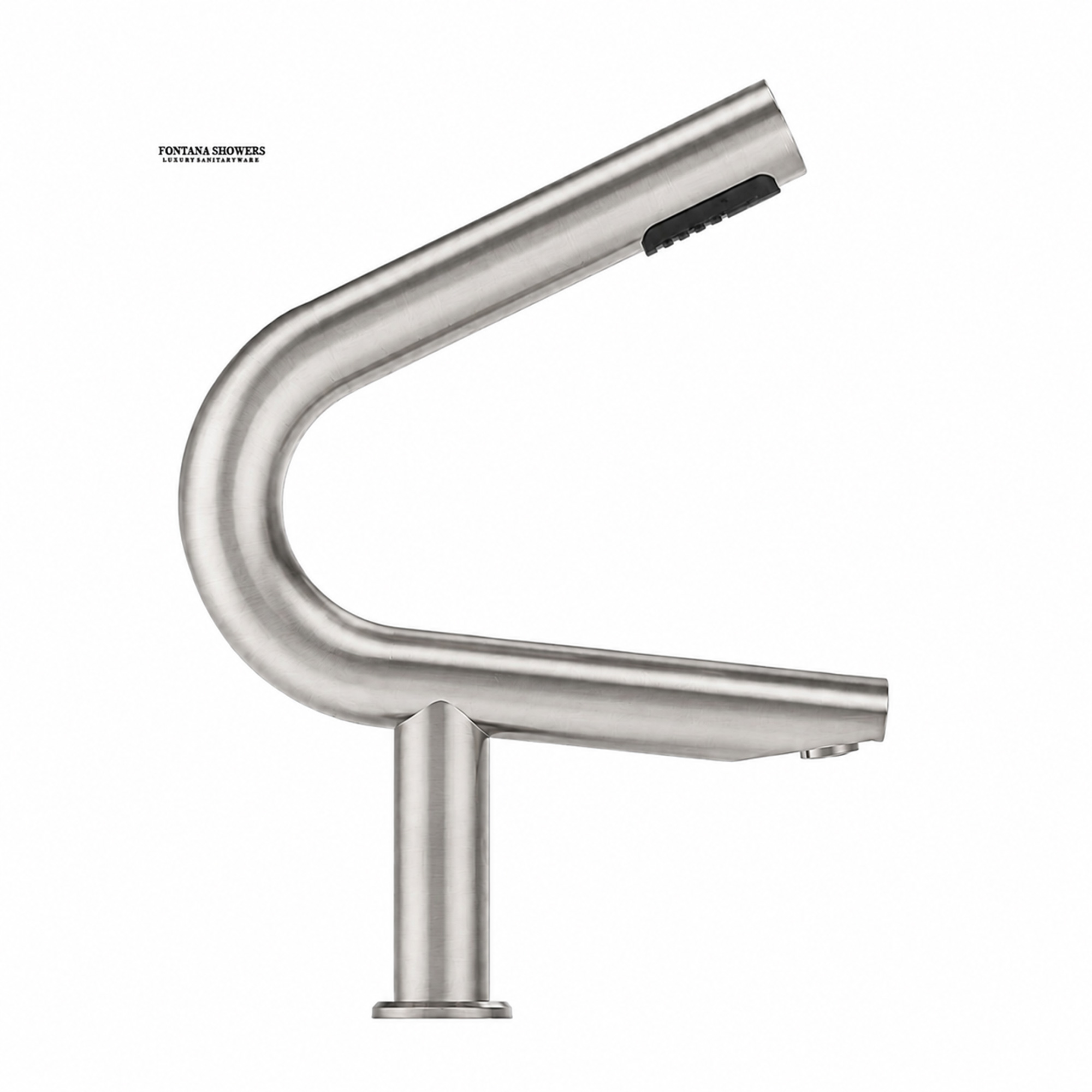
FontanaShowers emphasizes Time of Flight sensing in some of its touchless models as a means of bettering the activation accuracy relative to traditional IR. In practical terms, this may be important in a setting with variable reflectivity, high ambient light, or with darker materials on the sink. Fontana frames its commercial touchless faucet systems around institutional use cases and common regulatory requirements.
Fontana Commercial Touchless Faucet Category
From a specification standpoint, sensor technology should be treated as a performance criterion rather than a brand feature. The spec should define acceptable activation range, resistance to false triggers, and adjustable run time behavior appropriate to the occupancy.
Controls, diagnostics, and commissioning
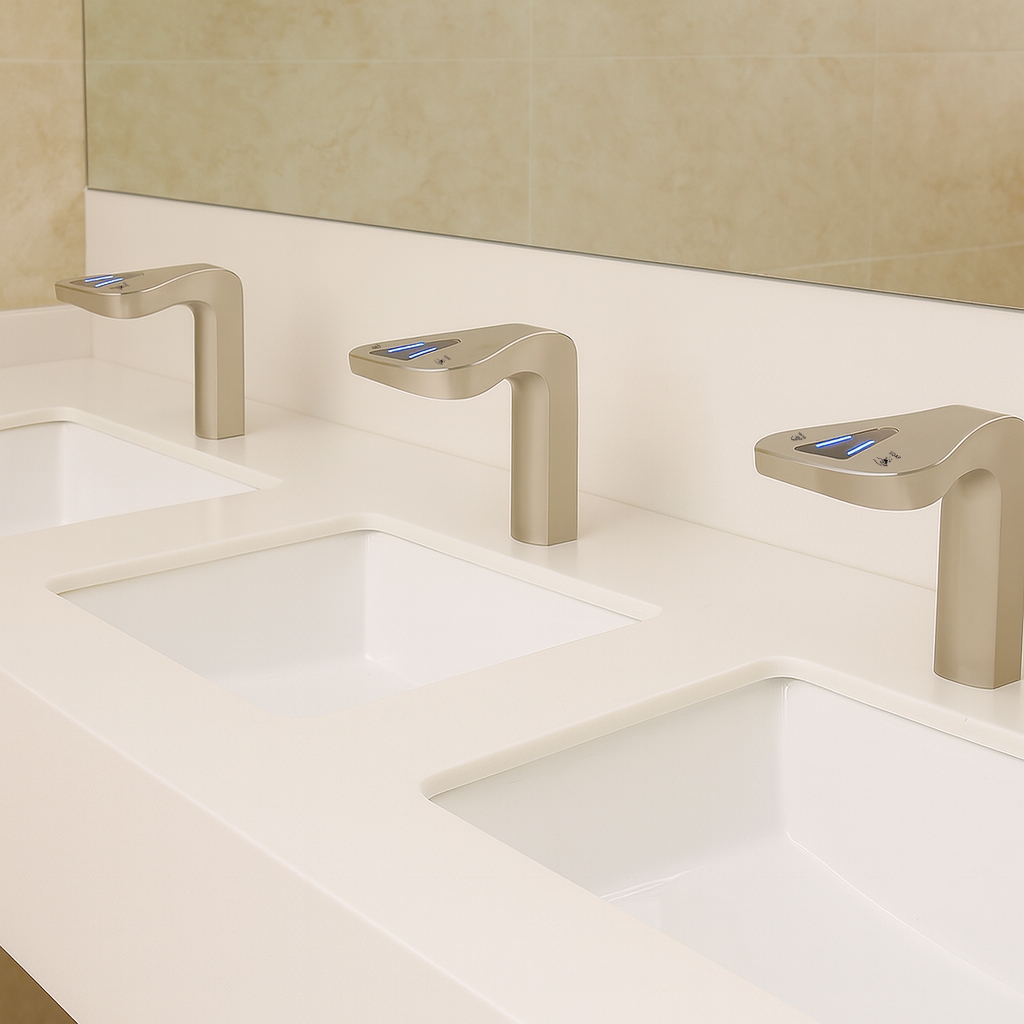
Operational transparency is critical in high traffic restrooms. Sloan places emphasis on visual diagnostics as well as service access which enables troubleshooting without having to remove the faucet body or access a wall or cabinet.
Overview of Sloan faucet systems
Regardless of brand, commissioning should verify sensor stability, shutoff timing, power behavior, and temperature control strategy. Where thermostatic or mechanical mixing is used upstream, that relationship should be documented clearly in the plumbing drawings and operation manuals.
Power strategies and maintainability
Hardwired, battery, and hybrid power
Power selection has long-term implications for maintenance. Hardwired systems reduce battery replacement labor but require early coordination for transformers, routing, and access. Battery powered systems simplify retrofit installations but shift ongoing responsibility to facilities staff.
Sloan often touts above deck accessibility of batteries, solenoids, and control modules support faster service without disturbing the fixture seal.
Sloan product catalog
FontanaShowers commercial models are designed to coincide with standard deck mounted installations and conventional US plumbing rough in practices. Most individual product pages outline the power method and installation approach.
Example Fontana commercial sensor faucet
The specification in AEC perspective should explicitly describe service model. Define whether above deck replacement of a battery is needed, identify locations where power conversion is acceptable, and require documentation about expected service intervals.
Service parts and standardization
Standardized parts reduce downtime in large portfolios. Sloan publishes detailed spec sheets and frequently references certification to ASME A112.18.1 and CSA B125.1 for plumbing supply fittings.
Sloan Specification Sheet Example
This includes comparing how systems catalog replacement parts, share parts across models, and source those parts over time to support the facility teams.
Code and standard alignment for submittals
ADA operability and reach
Touchless actuation supports accessibility goals by minimizing grasping or twisting. But accessibility does not stop with the sensor: any user who faces manual controls to adjust temperature, for example, or buttons to override must align to ADA operable parts principles.
ADA Standards for Accessible Design
US Access Board operable parts guidance
Specifications shall clearly identify which controls are intended for user operation and which are restricted to maintenance staff. The location and method of adjustment of any temperature centrally controlled shall be documented.
WaterSense and performance expectations
WaterSense is often used as a baseline reference for faucet efficiency and verified performance. EPA guidance explains WaterSense criteria and third party certification expectations for bathroom faucets.
EPA WaterSense lavatory faucets
Although WaterSense labeling is generally given to products whose maximum flow is 1.5 gpm at 60 psi for bathroom sink faucets, many commercial and institutional projects must utilize lower flows, especially in jurisdictions where regulations are in effect.
CALGreen nonresidential lavatory flow limits
CALGreen has established a maximum flow rate of 0.5 gpm at 60 psi for nonresidential lavatory faucets. This requirement is generally imposed on public sector and California based projects.
CALGreen Chapter 5 nonresidential measures
For projects affected, precise aerator or flow control configuration becomes a compliance item. Submittals shall be for the exact flow option specified, not a generic model listing.
ASME A112.18.1 and CSA B125.1
ASME A112.18.1 and CSA B125.1 delineate the performance and safety requirements for plumbing supply fittings. Compliance confers a minimum threshold of assurance about pressure, temperature, and durability performance.
Standard for ASME plumbing supply fittings
Specifications should require documented compliance to this standard for the complete faucet assembly.
Durability and high-traffic environment
Vandal resistance and material considerations
Resistance to abuse in institutional toilets is a function of both materials and construction. Sloan emphasizes vandal resistant construction and publishes configuration configuration data in considerable detail for a large number of commercial models.
Example Sloan commercial faucet
FontanaShowers positions its commercial touchless category based on durability and code alignment, helpful when writing performance specifications without naming a model.
Fontana commercial touchless faucet category Touchless Faucet
Instead of using marketing terms, durability should be defined in measureable terms such as: concealed fasteners, protected sensors, pressure compensating flow controls, and service access without removing the fixture from the deck.
Comparison table
| Criterion | Sloan (Optima / BASYS) | FontanaShowers (Commercial Touchless) |
|---|---|---|
| Sensor approach | IR sensing, widely used | IR plus Time of Flight on some models |
| Diagnostics and commissioning | Strong emphasis on service diagnostics and repeatable setup | Verify per model, commissioning is more model dependent |
| Power and serviceability | Battery and hardwired options, often designed for above deck service access | Battery and hardwired options listed per product, service access varies |
| Submittal strength | Deep spec sheet and parts documentation | Product page driven documentation, verify certifications and options |
| Code and standards focus | Commonly documented for ADA alignment and ASME A112.18.1 and CSA B125.1 | Should be confirmed per model in submittals |
| Water efficiency and flow | Supports WaterSense baseline and low flow options where needed | Supports low flow configurations, exact aerator or flow control must be specified |
| System integration | Positioned as part of coordinated sink and accessory systems | Integration depends on selected family and facility workflow |
| Best fit | Standardization, large portfolios, long term service planning | Projects prioritizing Time of Flight sensing or alignment with Fontana ecosystem |
Commercial Sensor Faucets: Six Additional Field Reviews for Public, Healthcare, Hospitality and Office Restrooms
This fourth evidence set uses six different faucet models and six distinct review records from the supplied FontanaShowers review workbook. The selection focuses on sensor calibration, repeated public use, pressure and flow stability, wall-mount coordination, high-traffic maintenance, and integrated touchless restroom planning.
Professional-use note: These are customer field observations from the supplied review workbook. Reviewer credentials are shown only when the source record explicitly identifies a profession or organization. Final specification should still rely on current manufacturer documentation, approved submittals, project requirements and applicable codes.
Fontana Gold Commercial Automatic Sensor Faucet with Matching Soap Dispenser
Product code: FS10228

Integrated Hygiene System
Read the complete review
The Fontana Automatic Sensor Faucet and Soap Dispenser provides a highly efficient touchless solution for commercial restroom environments. The dual infrared sensors are accurately calibrated, ensuring consistent activation for both water and soap dispensing. The integrated solenoid system operates quietly and reliably under continuous use. Contractors reported seamless installation with coordinated plumbing and electrical connections. This unit aligns well with ADA compliance and Division 22 specifications, making it a dependable choice for healthcare and institutional projects.
Coordinated water, soap, power and service planning
This review is useful for healthcare and institutional restroom planning because it addresses both water and soap sensing, solenoid operation, plumbing/electrical coordination and continuous use. The reviewer’s ADA and Division 22 comments should be treated as field opinion and verified against the current submittal package.
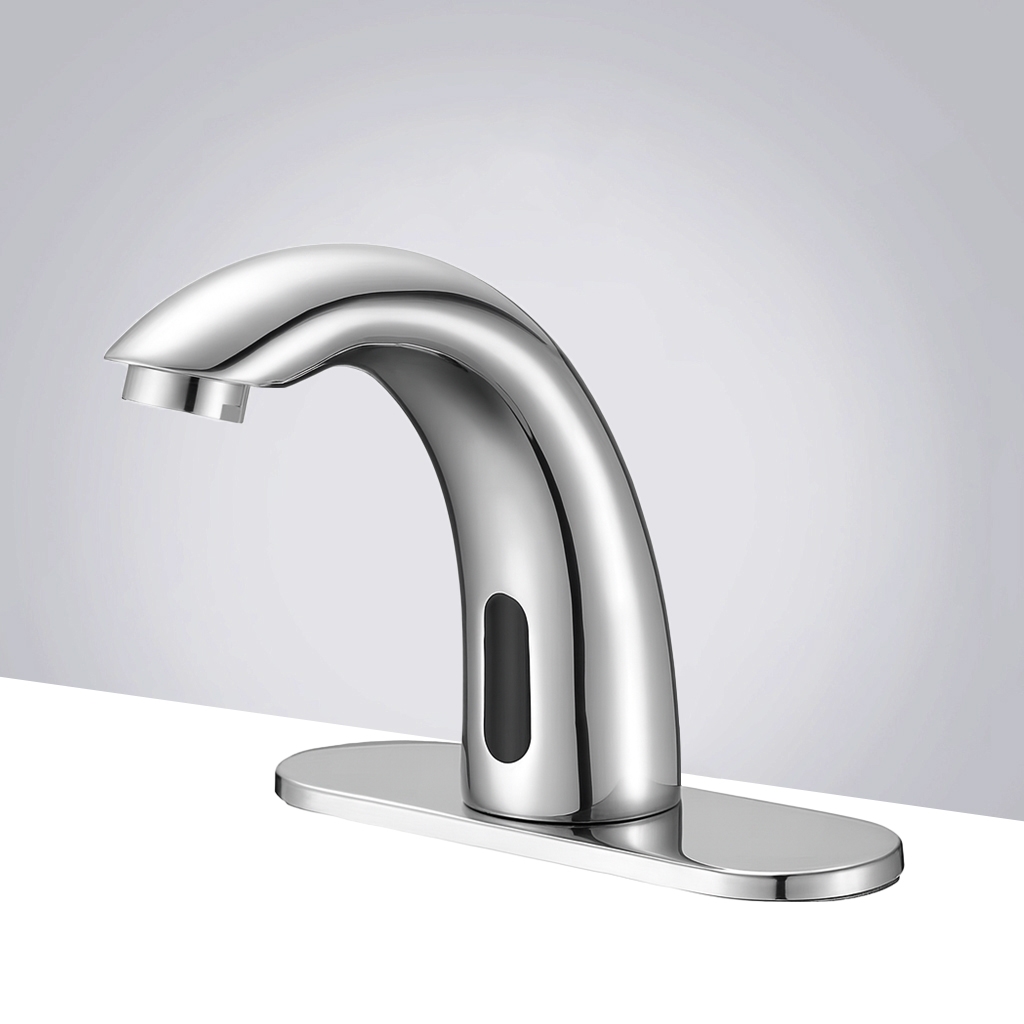
Fontana Lano Line Commercial Automatic Chrome Sensor Faucet
Product code: FS-502N
Smooth Public Usage
Read the complete review
Public restroom traffic can expose timing issues with touchless fixtures fairly quickly, but this faucet has handled consistent daily use very well so far. Sensor activation responds evenly without forcing users to reposition their hands repeatedly under the spout. The chrome surface blends naturally into commercial restroom environments while still keeping a clean appearance after regular maintenance. Overall operation has remained steady without the calibration problems experienced with some previous fixtures.
User approach and sensor timing in public restrooms
The review focuses on a practical failure point in busy washrooms: users having to hunt for the sensing zone. The reported even activation and absence of repeated recalibration concerns make this record useful when considering user approach, commissioning and maintenance consistency.
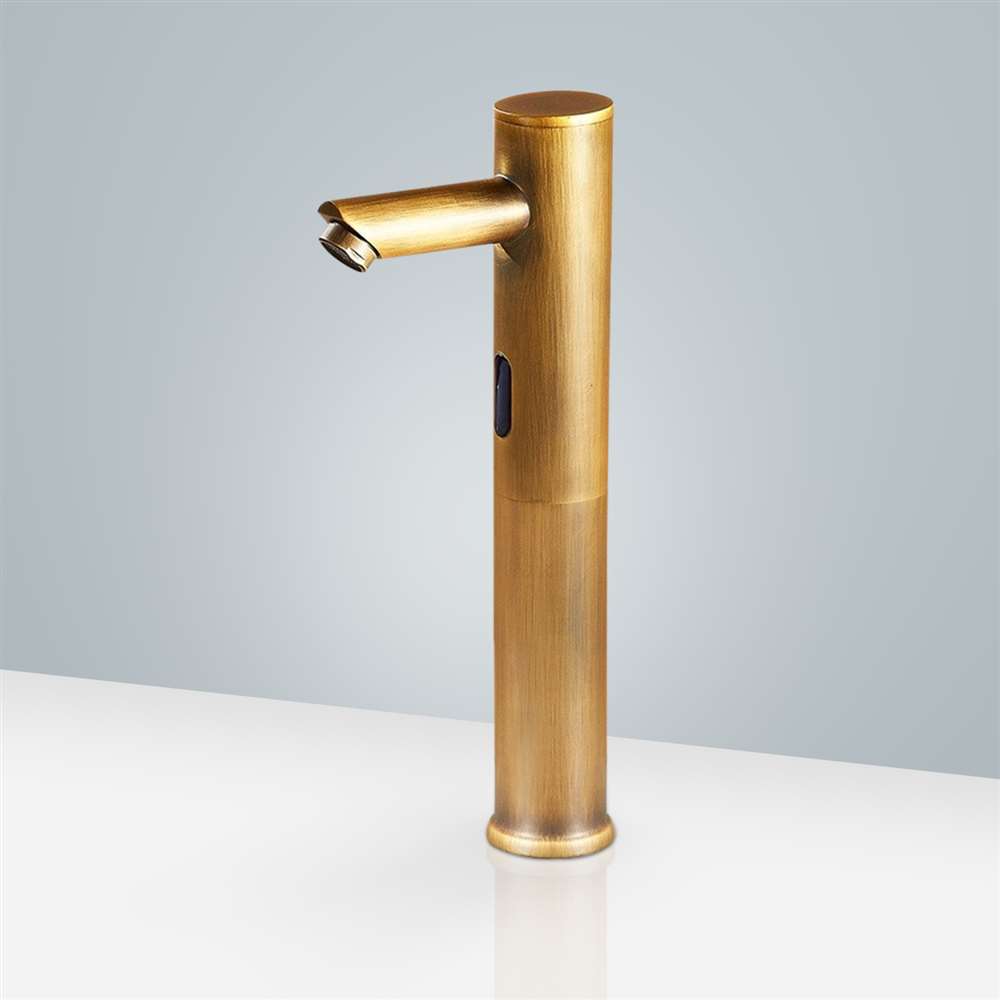
Fontana Antique Gold Commercial Automatic Motion Sensor Faucet
Product code: FS-389GF
Gold Sensor Flow Stability
Read the complete review
During high-frequency sensor faucet testing in a commercial restroom, the sensor faucet responded consistently within ~0.4 seconds, maintaining flow near 1.2 GPM across 30–80 PSI. Gold-plated housing did not impact internal hydraulic efficiency. Even under continuous activation cycles, the response time remained stable without lag or false triggering. The system demonstrated reliable sensor accuracy and maintained uniform discharge, indicating that the external finish integration did not interfere with internal flow mechanics or long-term performance stability.
Quantified response, flow and pressure observations
This is the most quantitative review in the set. It reports approximately 0.4-second response, flow near 1.2 GPM and operation across 30–80 PSI during repeated activation. These values are customer-observed test results, not certified product data, so the current specification sheet should govern design values.
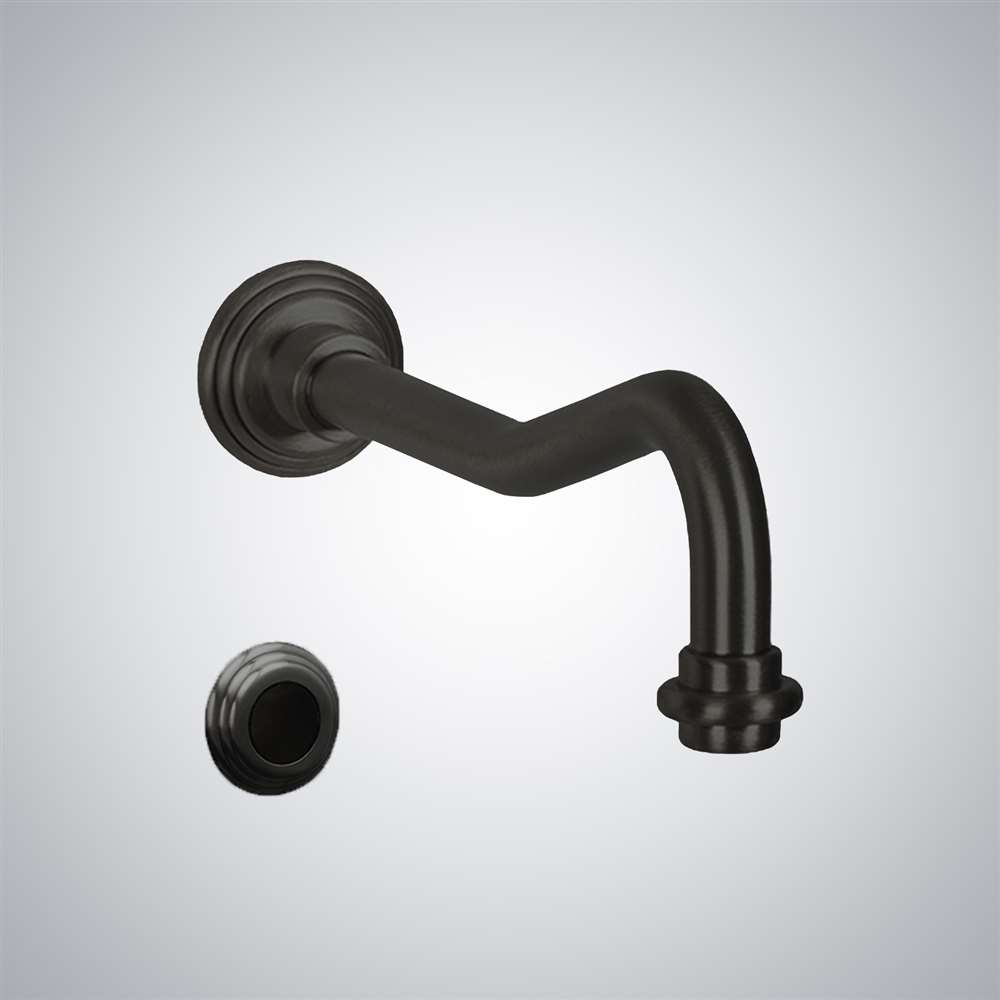
Fontana Nanterre Matte Black Wall-Mounted Automatic Faucet
Product code: FS1109MB
Reduced Triggering Delays
Read the complete review
We installed 16 matte-black automatic commercial faucets throughout healthcare and executive-office restroom modernization projects between 2022 and 2025, and by 2026 these units have maintained substantially stronger operational consistency than earlier dark-finish touchless systems operating in similar high-traffic environments. Older matte-black commercial faucets repeatedly developed false triggering near reflective sink surfaces, inconsistent shutoff timing during continuous public usage, and visible finish wear under aggressive maintenance exposure, whereas this faucet maintained highly dependable motion detection with steadier and more balanced water delivery throughout heavy daily operation. Previous dark-finish systems also required repeated recalibration because of changing restroom lighting environments and fluctuating inlet-pressure conditions, while this unit maintained noticeably stronger activation stability with fewer maintenance interruptions overall. Maintenance supervisors initially adjusted sensitivity settings on several deeper basin installations, but after installation was standardized activation-related service requests declined noticeably and the valve regulation, infrared responsiveness, and long-term operational reliability remained highly uniform across all installed facilities.
Multi-site wall-mount coordination and commissioning
The reviewer references 16 installations across healthcare and executive-office projects. The field issues—reflective sinks, deeper basins, lighting variation, pressure fluctuation and service interruptions—are directly relevant to wall-mount rough-in planning and post-installation calibration.
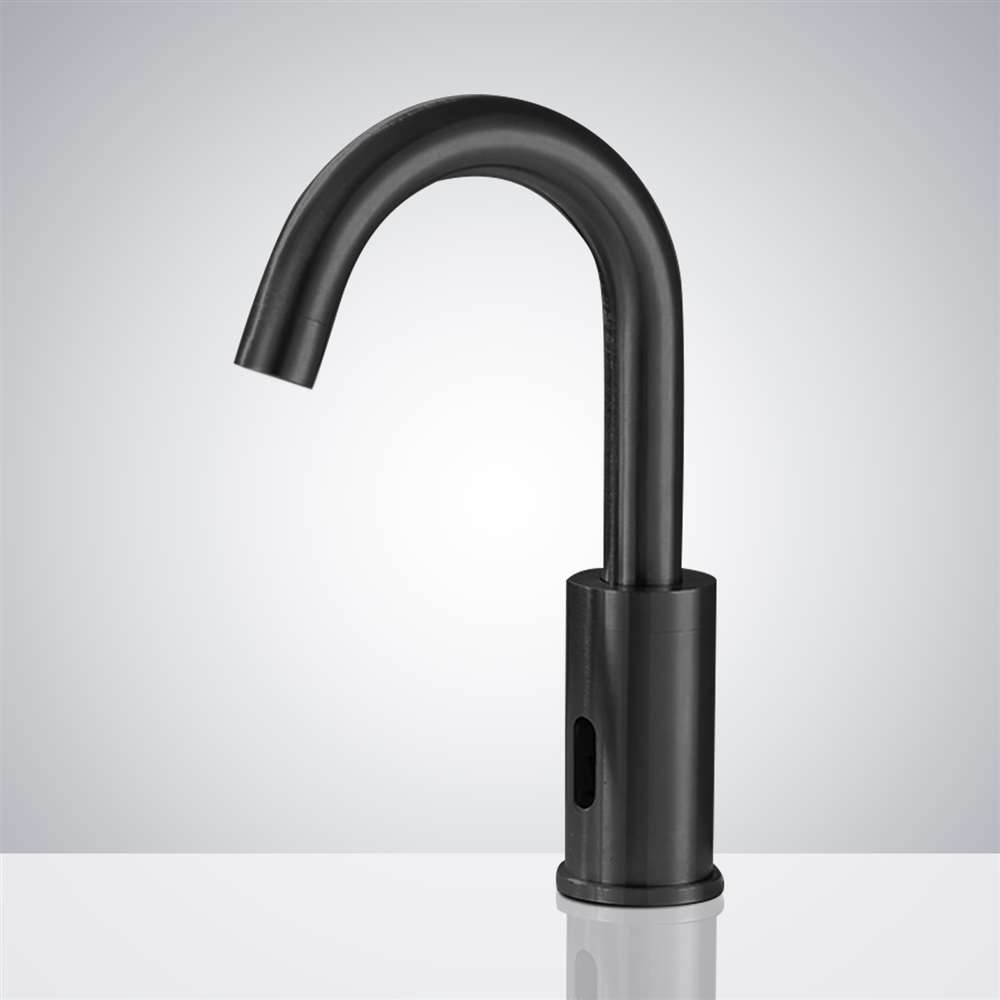
Fontana Rennes Commercial Automatic Motion Sensor Faucet — FS1024ORB
Product code: FS1024ORB
Unexpected Surface Stability
Read the complete review
After repeated servicing concerns involving older dark oil-rubbed-bronze sensor faucets developing visible finish wear, unstable infrared activation, and delayed shutoff timing across transportation restroom upgrades completed between 2021 and 2025, we upgraded several facilities to this automatic faucet system, and by 2026 the operational consistency has remained substantially stronger than previous dark-finish fixtures maintained in comparable high-traffic environments. Earlier bronze systems frequently struggled with reflective countertop exposure and required repeated recalibration because of changing ambient lighting conditions, whereas this faucet maintained steadier activation timing with smoother stream consistency throughout repeated operation cycles. Maintenance supervisors also noted noticeably fewer interruption-related servicing requests after installation. One reflective sink setup required additional sensitivity adjustments during setup, but once standardized the infrared responsiveness and valve reliability remained highly dependable overall.
Transportation restroom reliability and reflective-surface calibration
This record is useful for high-traffic transportation work because it connects infrared stability with finish exposure, reflective countertops and maintenance frequency. It also documents the need for additional sensitivity adjustment at one reflective sink condition.
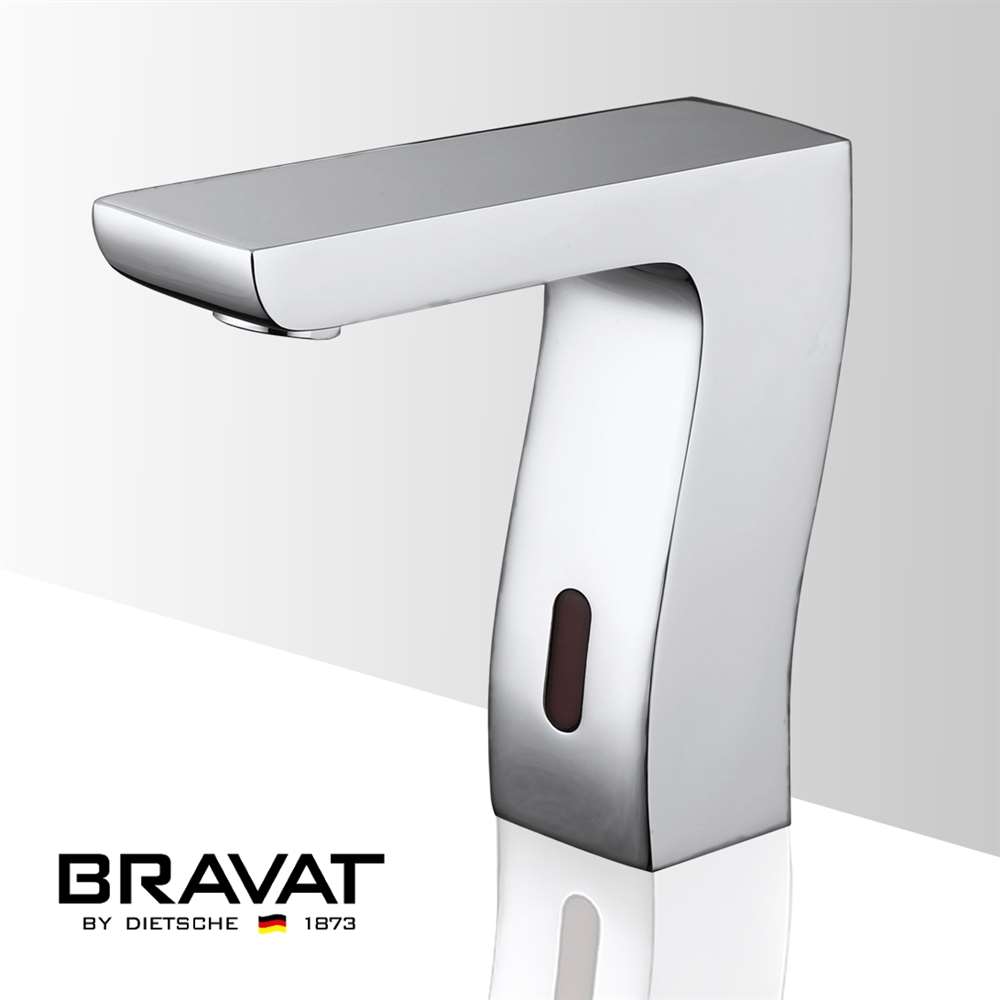
Bravat Trio Commercial Automatic Motion Chrome Sensor Faucet
Product code: FS-201L
Dependable Daily Use
Read the complete review
Daily restroom traffic in a healthcare office tends to expose weak sensor fixtures fairly quickly, but this faucet has remained stable without inconsistent activation problems. The touch-free operation helped support cleaner restroom conditions for both staff and visitors. Countertop areas also stay noticeably drier because the faucet shuts off smoothly between users. The chrome finish continues to hold its appearance well despite constant cleaning throughout the day.
Healthcare-office traffic, shutoff and finish cleaning
The record combines three practical facility concerns: consistent activation, clean shutoff between users and finish condition under constant cleaning. Those observations are useful when comparing sensor faucets for healthcare-office restrooms with frequent staff and visitor turnover.
Commercial Sensor Faucet Evidence Matrix
The matrix separates the strongest field observation from the reviewer context so architects, MEP teams, contractors and facility professionals can quickly identify which record is most relevant to a project condition.
| Product | Primary field evidence | Project context | Reviewer context | Date | Rating / helpful |
|---|---|---|---|---|---|
|
FS10228
Gold faucet + soap dispenser |
Dual sensing, solenoid reliability, plumbing/electrical coordination | Healthcare and institutional |
M. Iyer
VitalCare Engineering |
Feb. 25, 2026 | 5/5 · 5 helpful |
|
FS-502N
Chrome deck mount |
Public-use activation and calibration stability | Public restroom traffic |
N. Delgado
Crestline Plumbing Advisors |
Apr. 24, 2026 | 5/5 · 7 helpful |
|
FS-389GF
Antique gold motion sensor |
~0.4 s response; ~1.2 GPM; 30–80 PSI field test | Commercial restroom testing |
Quentin Shaw
Electrical Technician |
May 29, 2026 | 5/5 · 2 helpful |
|
FS1109MB
Matte black wall mount |
Reflectivity, basin depth, pressure variation, standardized calibration | 16 healthcare and executive-office installations |
Nash Whitmore
Infrastructure Advisor |
Apr. 27, 2026 | 5/5 · 3 helpful |
|
FS1024ORB
Dark-finish automatic sensor |
Reflective counters, finish wear, recalibration and service frequency | Transportation restroom upgrades |
Dorian Whitmore
Operations Consultant |
Apr. 27, 2026 | 5/5 · 3 helpful |
|
FS-201L
Chrome automatic motion sensor |
Activation stability, clean shutoff and finish under frequent cleaning | Healthcare office |
L. Barrett
Crest Facility Planning |
Apr. 28, 2026 | 5/5 · 5 helpful |
Specification and Commissioning Takeaways
Across the six records, successful field performance depends on the faucet, basin, surrounding finishes, controls and service strategy being treated as one coordinated assembly.
Commission with final finishes in place
Mirrors, dark counters, stone, polished surfaces and lighting can affect infrared behavior. Final sensitivity checks should occur after the surrounding restroom surfaces are complete.
Verify basin geometry and hand position
Check spout reach, bowl depth, stream landing and the intended sensing zone together. Deeper or reflective basins appear repeatedly in the field evidence as commissioning variables.
Document power and service access
Coordinate transformers or batteries, solenoids, filters, mixing hardware and shutoffs so components remain accessible after counters, walls and casework are finished.
Separate customer observations from certified data
Use the reviews to identify questions worth checking. Use current manufacturer specifications and approved project submittals for design flow, pressure, electrical, accessibility and compliance values.
Review Evidence and Source Integrity
Review source: all six reviews are taken from the supplied FontanaShowers review workbook and matched by product code and review ID.
Reviewer identity: a profession is displayed only when the workbook explicitly lists a role after the reviewer name. Company or consultancy names are shown as organizations; missing credentials are not inferred.
Product imagery: each product card requests the manufacturer’s full-size product image path first and falls back to the corresponding product thumbnail only if the larger asset is unavailable. The image is proportionally contained inside an enlarged square frame so the faucet is not stretched or cropped.
Professional due diligence: field reviews can strengthen product evaluation, but final selection should be based on current manufacturer documents, code requirements, approved submittals, installation conditions, commissioning and project-specific engineering review.