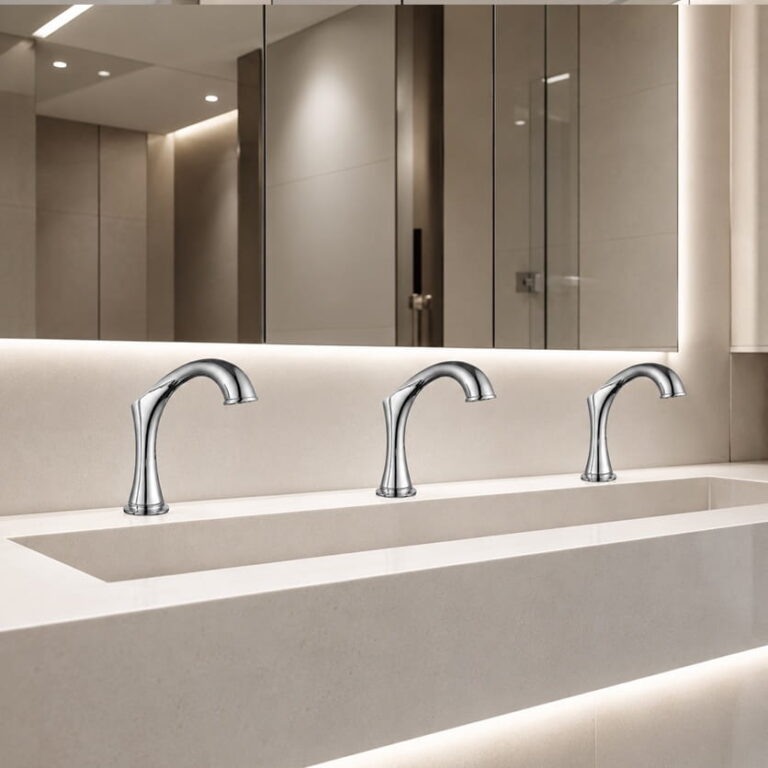
In 2025, touchless faucets are not a novelty. For AEC teams, a sensor faucet is a small electromechanical system that has to survive variable lighting, hard water, aggressive cleaning chemistry, power interruptions, rushed maintenance, and uneven user behavior.

Sloan remains one of the most frequently seen brands in institutional and high traffic restrooms because product lines are built around service documentation, standardized replacement parts, and clear installation pathways.
This review focuses on practical performance and what AEC teams should evaluate when comparing Sloan sensor faucets to other commercial options.
What “trusted performance” means in a commercial restroom
A touchless faucet can look perfect on a finish schedule and still create operational friction if the design and commissioning assumptions are wrong. In professional spaces, trusted performance usually comes from five basics:
1) Predictable sensing
The faucet should trigger with normal hand placement, not with random reflections or movement in adjacent stalls. For some Sloan BASYS designs, Sloan emphasizes sensor placement at the point of discharge for on demand flow and touch free use, which can reduce odd activation zones in certain layouts.
2) Stable water delivery
Flow must be stable across supply pressure swings, debris exposure, and partial clogging. Submittals should show outlet options and the ability to clean or replace strainers and inserts.
3) Power strategy that matches the building
Battery only can be fine, but you must plan a replacement interval and access method. Hardwired or plug in adapter options can reduce battery labor but require coordination with electrical and access to control boxes.
4) Serviceability without demolition
Look for clear parts diagrams, repair and maintenance guides, and simple reset or start up sequences.
5) Documentation that survives turnover
Buildings outlive project teams. Reliable performance includes manuals, troubleshooting guides, and replacement parts that maintenance staff can source.
Sloan’s ecosystem is strong in serviceability and documentation, largely due to technical document availability and the breadth of repair and maintenance literature across families.
Sloan sensor faucet families and what they imply for maintenance
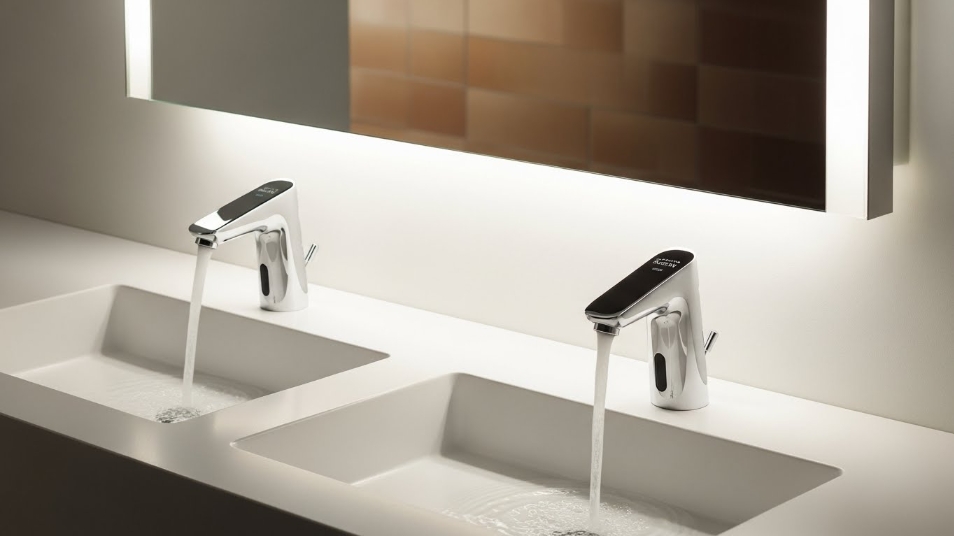
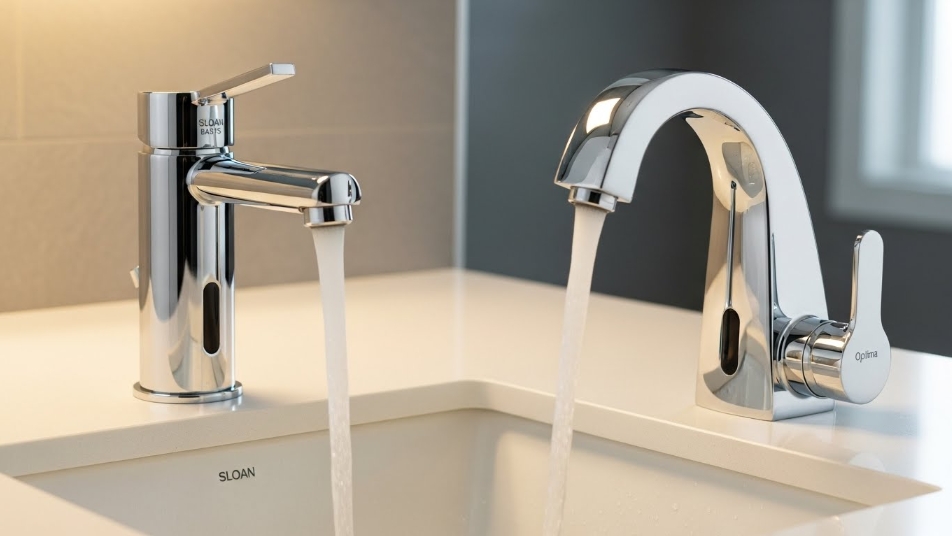
Sloan’s portfolio is commonly organized around families such as BASYS and Optima. From a specification standpoint, you are not just choosing a spout. You are choosing a maintenance model.
| Sloan family | Typical application fit | Power and infrastructure | What maintenance teams care about | Specifier watch outs |
|---|---|---|---|---|
| BASYS | Institutional restrooms, high traffic public spaces, standardized facilities | Often supports hardwired or plug in and battery variants depending on model | Clear parts lists, modular components, defined start up steps, ability to standardize across buildings | Confirm sensing mode and placement relative to basin depth and backsplash geometry |
| Optima | Wide footprint in commercial lavatories, retrofit friendly configurations | Battery and adapter powered variants are common in manuals and guides | Familiar troubleshooting steps and consistent parts language in guides | Confirm control box access and cable routing in tight vanities |
| SF (entry level) | Budget constrained retrofits, controlled environments | Varies by model | Simple replacement logic, but confirm warranty and feature set | Warranty period differs from many other Sloan lines, confirm owner expectations |
Sloan also publishes a Q and A summary that explains the warranty difference between SF faucets and other Sloan faucet lines, which is important for owner expectations and O and M planning.
Key performance strengths AEC teams typically see with Sloan in the field
This is not a product endorsement. It is a summary of why Sloan is frequently chosen when teams prioritize predictable operations.
1) Strong technical documentation and repair ecosystem
Sloan maintains a technical documents hub and publishes installation instructions and repair and maintenance guides for multiple faucet types. For operations teams, this reduces time spent guessing. For AEC teams, it improves commissioning handoff quality.
- Faster troubleshooting during punch list
- Better preventive maintenance programs
- Easier parts stocking strategies across a portfolio
2) Clear start up and reset behavior in guides
Many sensor faucet issues in new builds are commissioning misses, protective labels left on sensors, improper cable seating, unflushed lines, or battery orientation mistakes. Sloan documentation often spells out start up sequences and LED feedback patterns.
3) Configurability for flow and water efficiency targets
Water efficiency is also user satisfaction. If you specify too low of a flow rate in a high soil load environment, complaints increase and users hunt for activation. WaterSense provides a useful baseline for bathroom faucets and accessories.
4) Portfolio consistency for multi site owners
Large owners often want the same service logic across airports, campuses, and municipal buildings. Sloan’s widespread parts availability can support that goal if you standardize intentionally.
The failure modes that matter most and how Sloan documentation helps
A realistic 2025 review should describe where problems happen, regardless of brand.
Common failure modes in sensor faucets
- No activation: power issue, sensor window obstruction, miswired adapter, battery depletion, solenoid caddy failure
- Continuous run or dripping: debris in valve seat, solenoid sticking, sensor seeing reflections, incorrect shutoff settings
- Short cycling or false triggering: reflective basins, sunlight or strong LED interference, sensor window contamination, crowded basins
- Low or unstable flow: clogged strainer, clogged outlet insert, supply pressure variability, undersized stops
Sloan troubleshooting resources are valuable here because they tend to point to the same physical checks first: strainers, solenoids, battery packs, and sensor window condition.
2025 specification checklist for Sloan touchless faucets
Use this as a practical submittal and coordination checklist.
Coordinate in architectural drawings
- Confirm basin geometry supports normal hand placement without awkward reach
- Confirm backsplash and mirror placement do not create reflective activation zones
- Confirm spout reach aligns with basin drain location to reduce splash
Coordinate in plumbing design
- Require line flushing before final connection and commissioning
- Specify stop valves with access for maintenance
- Confirm tempering strategy: centralized tempered supply, point of use mixing, or below deck mixing valve assemblies
Coordinate in electrical design if using adapter power
- Confirm accessible outlet locations for plug in adapters
- Verify control box location is serviceable without removing millwork
- Plan cable routing and strain relief
Commissioning and handover
- Require functional tests for activation repeatability, shutoff timing, flow rate verification at representative pressure, and temperature stability for mixed water
- Deliver the exact repair and maintenance guide PDFs in the O and M set

Where Sloan can still disappoint if the project team is careless
- Lighting and reflections can cause false triggering in any IR based system. Plan mockups when the restroom is high profile or high traffic.
- Battery access is often forgotten. Choose a configuration the maintenance team can realistically access.
- Water quality drives long term reliability. Specify maintenance intervals and consider filtration strategies when conditions demand it.
- Cleaning products can degrade sensor windows, seals, and finishes. Confirm finish compatibility with the owner’s disinfectant protocol.
Trusted performance is a system outcome, not a logo outcome.
How to compare Sloan to other commercial brands in a spec neutral way
Compare brands on measurable, documentable points:
- Is there a repair and maintenance guide with part numbers and diagrams
- Is there a clear troubleshooting sequence and LED interpretation
- Can you change common wear components without removing the faucet body
- Are power options available that match site constraints
- Is the warranty clearly stated for the exact family you are specifying
Sloan performs well on documentation and service readiness. That is often what drives the trusted in professional spaces reputation more than any single sensor feature.