
Airports, universities, transit hubs, and large campuses punish plumbing hardware in ways that typical office restrooms do not. This guide compares Sloan and Chicago Faucets through an AEC lens, focusing on uptime, stability, and maintainability at scale.
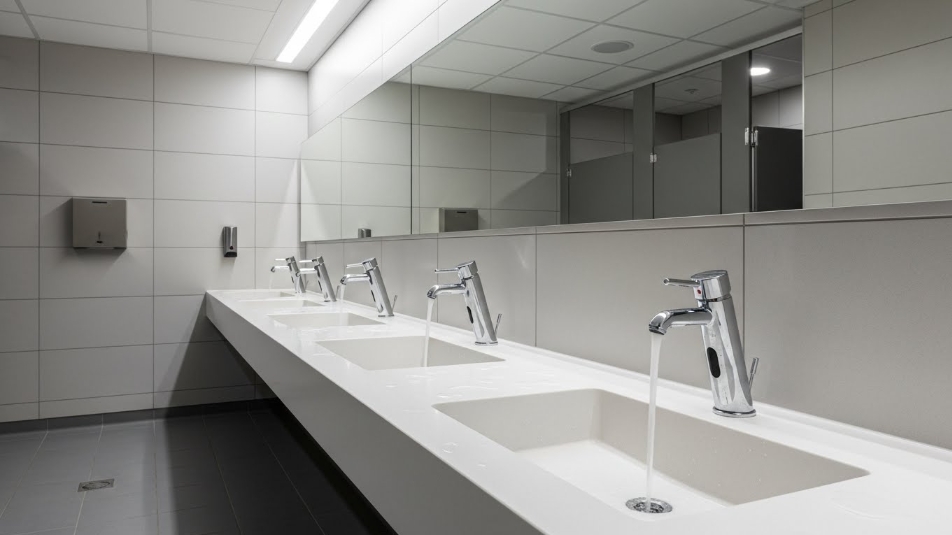
For touchless faucets, reliability is not just whether water comes out today. It is a lifecycle question: availability across heavy activation volume, stability under real lighting and reflective conditions, service time for technicians, and risk control for temperature, efficiency, and flushing.
- Availability: keeps operating across thousands of daily activations
- Stability: avoids nuisance behavior like random run on, false triggers, or no read events
- Service time: technicians diagnose and fix issues fast with minimal disassembly
- Risk control: supports safe temperatures, efficiency limits, and proactive flushing where stagnation is a concern
What “reliability” means in real institutional and airport work
Mechanical and hydraulic stressors
- Debris and scale loading inlet strainers and solenoids
- Supply pressure variation and temperature swings
- Aggressive cleaning chemicals and repeated wipe downs
- Hose routing mistakes causing kinks or stress on connectors
Electrical and controls stressors
- Battery depletion patterns that do not match published assumptions
- Loose connectors from vibration or repeated under deck impact
- Sensor window contamination from soap mist and hard water deposits
- Interference or reflective surfaces causing detection issues
Operational stressors
- Vandalism and testing behavior by the public
- Cleaning staff triggering sensors repeatedly during wipe downs
- Long periods of low use in some zones, then sudden spikes
- Seasonal shutdowns and recommissioning
When engineers say better reliability, they usually mean a platform that is more tolerant, easier to diagnose, and faster to restore.
Side by side view: how Sloan and Chicago approach “keep it running”
Both manufacturers offer proven sensor platforms and a typical mix of power options, flow controls, and accessories. In institutions and airports, reliability differences often show up in service workflow, configuration repeatability, temperature safety and flush capability, and how quickly a tech can isolate root cause.
Table 1: Reliability drivers that matter most
| Reliability driver | Sloan typical approach (examples: BASYS and connected options) | Chicago Faucets typical approach (examples: E-Tronic and CF Connect) | Why it matters in airports and campuses |
|---|---|---|---|
| Fast diagnosis | Repair guides emphasize structured troubleshooting and modular replacement strategy | User guides include symptom, possible cause, and corrective action workflows | Faster triage means fewer restroom closures |
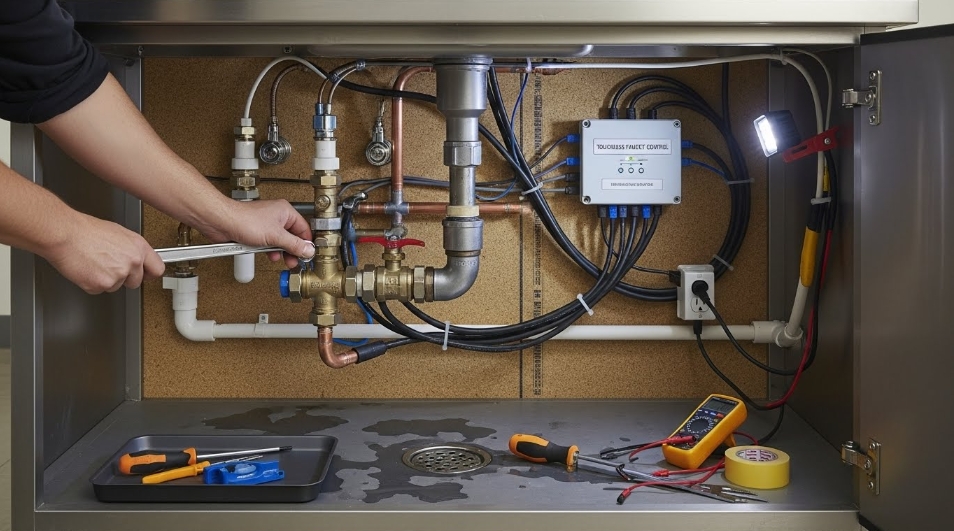
| Access for service | Many configurations support service workflows that avoid unnecessary disassembly | E-Tronic platforms are supported by service docs with clear parts and procedures | Under sink access is constrained in many institutional installs |
| Flushing and stagnation control | Connected features include line flush and setting changes without frequent cabinet access | CF Connect supports hygiene flush and pipe flush modes for device level management | Stagnation management is increasingly written into O&M expectations |
| Temperature safety | Options for thermostatic mixing strategies in commercial architectures | E-Tronic 80 offers an integrated ASSE 1070 scald protection option in certain configurations | Airports and schools often require stricter scald control at point of use |
| Commissioning at scale | Settings repeatability improves with digital tools and consistent accessories | Digital tooling supports configuring groups of devices and reducing manual tuning | A single terminal can have dozens or hundreds of faucets |
Chicago Faucets in institutional and airport settings
Strengths that typically support reliability
1) Clear service documentation and troubleshooting flow
User guides for touchless platforms include symptom based troubleshooting. That matters when the tech onsite is not a brand specialist and needs an answer quickly.
2) Options for digital configuration and hygiene flush
The ability to adjust settings without repeatedly opening under sink spaces can reduce labor when used thoughtfully. CF Connect positions hygiene and pipe flush capabilities for device level management.
3) Institutional safety features for mixing and scald protection
E-Tronic 80 offers an ASSE 1070 thermostatic option for environments where point-of-use temperature limiting is required or strongly preferred.
Typical risk points to watch
- Filter clogging from construction debris after renovations
- Sensor window contamination from harsh cleaners or soap residue
- Poorly routed cables and hoses under the deck leading to strain
If you want long term reliability, make filter access and periodic maintenance realistic in the spec and submittals.
Sloan in institutional and airport settings
Strengths that typically support reliability
1) Strong maintenance documentation for common failure modes
Repair and maintenance guidance covers serviceable parts, wiring cautions, and power approaches that matter in multi-faucet rooms.
2) Connected configuration and diagnostics options
Connected workflows can reduce labor when they match the facility’s maintenance reality. The Sloan Connect ecosystem is positioned around settings changes, battery checks, line flush, and usage visibility.
3) Scalable power strategies
In multi-fixture rooms, power distribution design becomes a reliability issue. Improper power setups create nuisance faults that look like sensor problems.
Typical risk points to watch
- Debris during remodels clogging filters and solenoids
- Battery logistics across hundreds of fixtures
- Inconsistent commissioning that creates mixed user experiences across a terminal
Sloan tends to perform best when you standardize the configuration, document settings, and treat the faucet system like a maintainable asset.
The real differentiator: maintainability at scale
For airports and campuses, the question is rarely which faucet is better on day one. It is which platform is easier to keep consistent for five to ten years.
Table 2: Practical maintainability checklist for spec writers
| Spec and design decision | Why it improves reliability | What to include in documents |
|---|---|---|
| Require inlet filtration and service access | Prevents solenoid and flow instability, reduces nuisance failures | Accessible stops, filter service clearance, documented filter cleaning interval |
| Standardize flow rate and run time settings | Reduces complaints and inconsistent behavior across restrooms | Target flow (gpm), sensor range, run on time, safety shutoff |
| Plan for hygiene flush where stagnation is a concern | Reduces stagnation risk during low use periods or seasonal operations | Owner policy, flush schedule, commissioning verification steps |
| Specify point of use temperature limiting where required | Reduces scald risk and improves compliance | ASSE 1070 approach where applicable, max outlet temperature targets |
| Create a battery and parts plan | Prevents random outages and emergency orders | Approved battery type, replacement strategy, critical spare parts list |
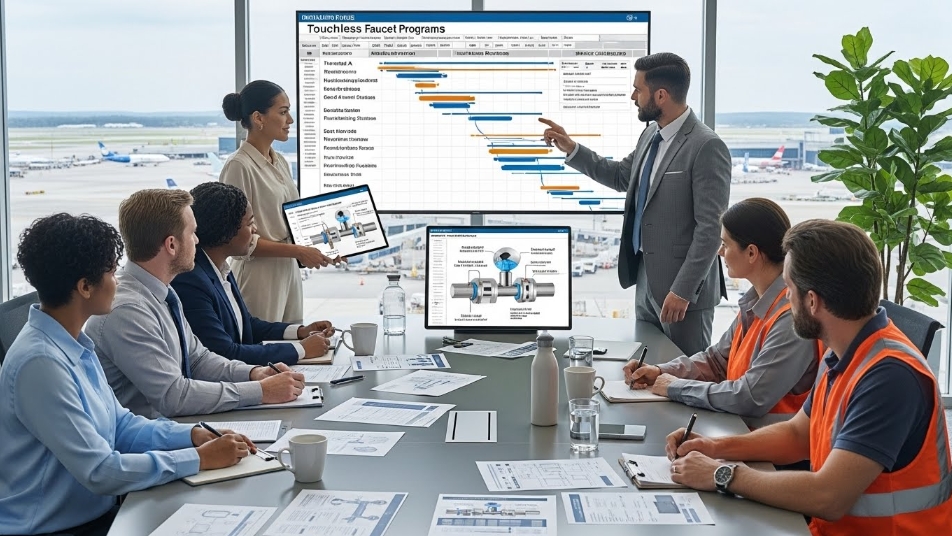
Airports vs institutions: different stress profiles
Airports
- Fast troubleshooting flow and clear diagnostics
- Stable sensing in reflective, brightly lit spaces
- Hygiene flushing capability for low use zones and overnight closures
- Service process that minimizes downtime per fixture
Universities and institutions
- Ability to standardize and repeat settings across many buildings
- Predictable parts strategy and training friendly documentation
- Water efficiency compliance support across jurisdictions
- Temperature control and user comfort to reduce complaints
Engineering considerations that can quietly destroy reliability
1) Water quality and strainers
Hard water and debris create symptoms that look like electronics failures. Design for filter cleaning as routine work.
Field tip: if flow becomes weak or inconsistent, clean the inlet filter before replacing electronics.
2) Power strategy
Battery can be reliable with logistics. Hardwired can be reliable with correct, serviceable electrical integration. Reliability improves when the power strategy, service access, and replacement plan are specified, not assumed.
3) Temperature management
If the facility needs ASSE 1070 temperature limiting, make it intentional, documented, and commissioned.
4) Water efficiency compliance
Flow rates are shaped by local codes and voluntary programs. Confirm targets early so commissioning does not drift.
So which is better for reliability in institutions and airports?
For maximum operational continuity, both brands can be specified successfully. The platform that performs better is the one that matches the owner’s maintenance reality.
- If the owner values structured documentation, platform options, and safety features, Chicago Faucets can be attractive.
- If the owner values standardization, scalable configuration tools, and proven commercial maintenance guidance, Sloan can be a strong choice.
The biggest reliability mistakes are usually not brand choices. They are inconsistent settings across identical rooms, poor under deck access, missing commissioning documentation, and no plan for filters, power, and flushing.
Support documents and source links
Chicago Faucets
Sloan
Category pages requested
BathSelect category link: to keep this accurate, paste the exact bathselect.com category URL you want used and I will add it here as a button with no tracking parameters.