
Accuracy • Accessibility • Water Performance • Reliability
Touchless faucets, flush valves, and dispensers are today considered basic infrastructure in commercial, institutional, and transportation environments. Performance directly impacts hygiene, user accessibility, water conservation, and plumbing system durability. For architects, mechanical engineers, plumbing designers, and specifiers, accuracy of sensors is one of the least consistently defined-but one of the most consequential-performance variables.
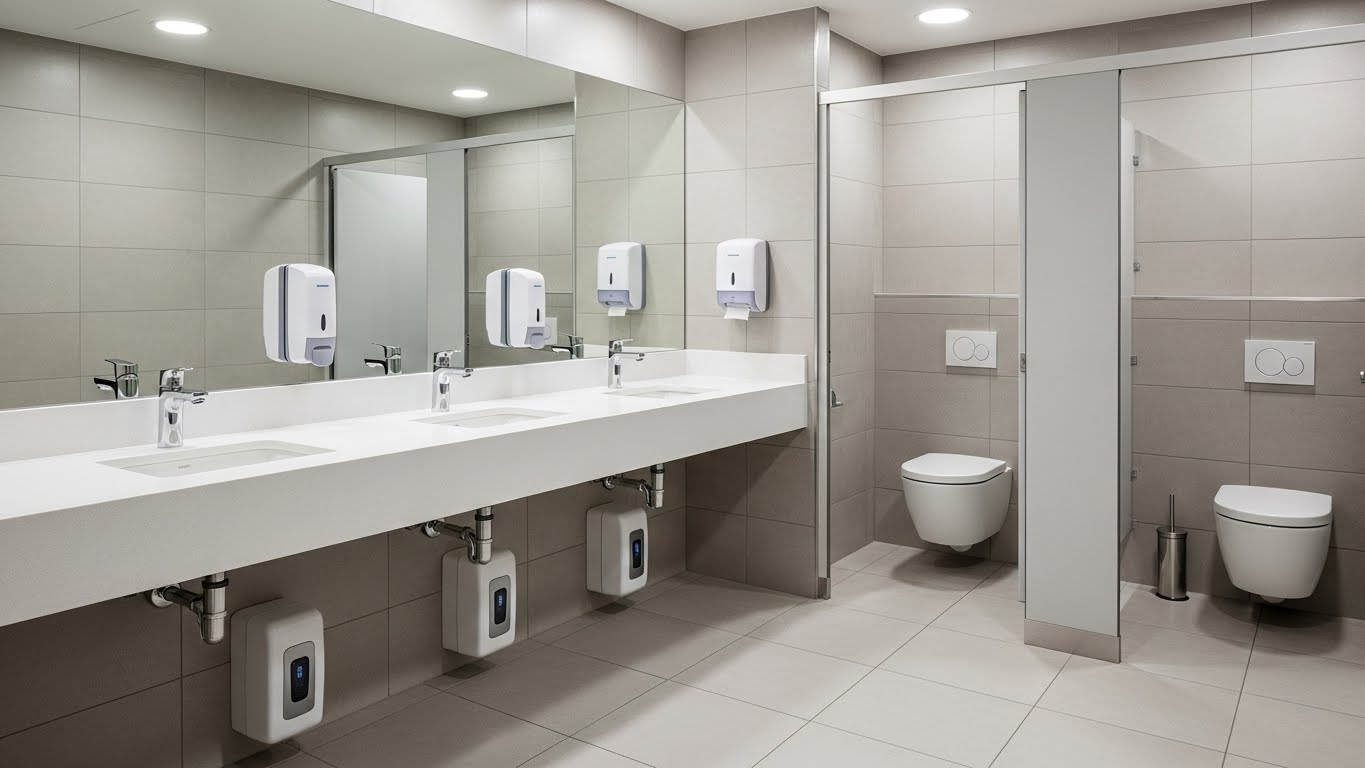
Inaccurate or unstable sensors are contributory factors to user frustration, non-compliance with accessibility requirements, avoidable water waste, and long-term maintenance burdens. This technical paper establishes performance benchmarks applicable to three major project types:
- Commercial and public restrooms
- Healthcare settings: acute care, outpatient, specialty care
- Air-ports and high-throughput transportation hubs
The performance of sensor-operated plumbing fixtures is likely to be impacted by cross-cutting requirements contained within the following frameworks:
Core Technical Concepts for Sensor-Operated Plumbing Fixtures
Operating Key Parameters
You will be able to specify sensor-operated faucets and flush valves more accurately by considering them as control systems, rather than just hardware. The parameters to remember are:
- Detection zone: A three-dimensional area in which presence is detected validly.
- Sensitivity/Threshold: Smallest change in signal (IR reflectance, capacitive field, ultrasonic return) that can be detected to create a system response.
- Valve actuation response time can be defined as the time difference between target detection and valve actuation.
- Deactivation Response Time – Time difference between target removal and flow stoppage.
- Hold-On/ Metering Time: Duration of water flow while presence persists or for a metered cycle.
- Lockout / Anti-Nuisance Delay: Minimum time between the activation cycles.
- False Activation Rate: Incidence of unintentional triggering because of reflections, passers-by, or cleaning activities.
- Failure-to-Activate Rate: Valid user attempts that do not trigger flow.
Each of those parameters must be assessed in variable conditions, such as pressure, lighting, reflective finishes, temperature/humidity, power quality, and representative user behavior.
Sensor Technologies and Engineering Implications
Common sensing modalities include:
- IR (Infrared): sensitive to reflectivity, basin geometry, and lighting conditions.
- Capacitive: Less affected by reflective surfaces, but highly dependent on grounding and environmental moisture.
- Ultrasonic: Used in some specialty fixtures; performance affected by airflow and acoustic noise.
What matters most from the AEC perspective is the reproducibility of accuracy across different geometries of installation and under varied environmental conditions.
Standards and Regulatory Framework
ADA Accessibility Requirements
Under 2010 ADA Standards (Sections 309 and 606)
Sensor-operated fixtures shall:
- Be operable without tight grasping, pinching or twisting.
- Provide activation zones within compliant forward or side reach ranges.
- Provide stable detection so that users do not have to make repeated or dexterous movements.
- Be coordinated with compliant knee and toe clearances at accessible lavatories.
Specifications should define:
- Verified ADA compliance for the entire assembled fixture and not just the sensor modules.
- Horizontal and vertical offsets from counter/lavatory edge to activation zone center
- Requirement of mock-up review for at least one accessible station per restroom bank
ASME A112.18.1 / CSA B125.1
Primary standard for plumbing supply fittings:
ASME A112.18.1 CSA B125.1 Plumbing Supply Fittings
ASME A112.18.1 Influences:
- Pressure and flow envelopes within which the sensors must operate reliably.
- Performance of endurance over hundreds of thousands of on/off cycles.
- Compatibility with low-flow WaterSense and CALGreen requirements.
WaterSense, DOE, and Flow Restrictions
EPA WaterSense criteria govern maximum faucet flow rates: typically 1.5 gpm or below
Sensor accuracy includes compliance because of:
- Increased consumption from nuisance activations.
- Longer run times to compensate for slow or under-sensitive detection.
- Failure to meet the modeled per-cycle water budgets.
CALGreen Water Efficiency Requirements
CALGreen Title 24, Part 11:
CALGreen drives:
- Very low maximum flow rates, such as 0.4 gpm for certain public applications.
- Tiered potable water reduction requirements: 12% Tier 1; 20% Tier 2.
- Documentation of modeled vs. actual water savings
At very low flows, even small changes in either sensor runtime or sensitivity can have a material impact on compliance.
Benchmarks of sensor accuracy in specific environments
1. Commercial and Public Restrooms
Applies to offices, retail, civic buildings, and education facilities.
Recommended Benchmarks (good practice values):
Detection Zone
- Horizontal: 75–150 mm (3–6 in) from outlet centerline
- Vertical: 25–100 mm (1–4 in) below outlet
Response Time of Activation: ≤ 0.5 s
Deactivation Response Time: ≤1.0 s
Maximum Run-On (fault): 30–60 s
Lockout Delay: 1–3 s
Reliability Targets:
- Failure-to-activate ≤ 1%
- Nuisance activation ≤ 1%
Architectural influences:
- Basin Geometry: Deep basins favor signal stability, while trough sinks require further coordination.
- Reflective Finishes: Polished surfaces can create IR reflections; adjustable sensitivity may be required.
- Lighting: Overhead downlights directly over the sensor can degrade IR accuracy; coordinate the placement of luminaires.
2. Hospitals and Healthcare Facilities
Sensor-operated fixtures add to infection prevention strategies and must function predictably with gloves, PPE, and frequent cleaning.
Increased demand for accuracy:
- Response Time: Target ≤ 0.3–0.4 s.
- Gloved-Hand Detection: Validate performance across nitrile, latex, vinyl gloves.
- Cleaning Chemical Resistance: Less than 2% drift in detection threshold after multiple exposures to disinfectants.
- Stable time-out settings in accordance with hand hygiene standards (20–40 s standard).
Clinical workflow considerations:
Under-performance leads clinicians to manually override controls or tap fixtures, undermining the protocols of IPC.
3. Airports and Transportation Hubs
High throughput, heavy luggage, and wide demographic variability put great demands on robust and intuitive sensor performance.
Throughput-oriented design benchmarks:
- Wide, shallow detection zones to support rapid hand placement without precision.
- Clear feedback indicators-LEDs or low-level audio cues.
- Peak-demand stability at high temperatures and during long high-duty cycles.
- Power quality resilience, including regulated low-voltage supplies, with a tolerance of ±10–15% voltage variation.
Durability, Environmental Robustness, and Power/EMC Considerations
Duration Benchmarks
- Commercial restrooms ≥ 500,000 cycles
- Airports/Transit Hubs: ≥ 1,000,000 cycles
- Threshold Drift of Detection: ≤ ±10% over endurance testing
- Failure-to-Activate Post-Test: ≤ 1–2%
Environmental Conditions
- Temperature: 0-40 °C; 32-104 °F interior; broader for semi-conditioned spaces
- Humidity: 10–95% RH, non-condensing
- Ingress Protection: Minimum IPX4 for exposed lavatory locations
Electromagnetic Compatibility
Hospitals and airports have dense RF environments; hence, these must be in compliance with applicable IEC/EN 61000 EMC standards.
Water Budgeting, Sustainability, and Sensor Logic Design
Link Between Sensor Accuracy and Water Performance
Water savings modeled rely on the following: CALGreen, LEED, or internal targets
- Fixture count
- design flow rate
- Occupant use assumptions
High nuisance activation or long run-times can reduce modeled 20% savings to 5–10% in operation.
Recommended Controls:
- Low flow rates (0.35–0.5 gpm typical for public settings)
- Tight metering times: 10–15 s
- Field commissioning to verify run times and trigger stability
Adaptive Algorithms
Some systems adjust sensitivity based on usage patterns. Specifications should require:
- Transparent adjustability without proprietary tools
- Limits to auto-adjustment to prevent drift outside of design tolerances
Integration with temperature control and water quality
Fixtures which support thermal disinfection or BMS-driven flushing shall:
- Accept override signals
- Return to normal mode without manual reset

System Integration and Telemetry
BMS/BAS Integration
Key questions for Division 22/25 coordination:
- Does the fixture report usage counts, fault states, or battery conditions?
- Does it support communications over BACnet/IP, Modbus TCP, or via gateway devices?
- Can facility operations track water-use performance relative to modeled values?
Cybersecurity Considerations
Network-connected plumbing devices shall:
- Operate on segmented OT networks
- Follow owner cybersecurity baselines for operational technology
Specification Strategies for Division 22
Recommended Specification Structure
Within 22 40 00 – Plumbing Fixtures include:
Regulatory Compliance
- ASME A112.18.1 / CSA B125.1
- ADA 2010
- WaterSense, CALGreen
Performance Requirements
- Flow/pressure ranges
- Detection zones
- Response times
- Nuisance/missed activation thresholds
- Environmental and endurance demands
Controls and Integration
- Field adjustability
- BAS/BMS connectivity
- Telemetry and alarms
Submittals
- Third-party listings
- Factory sensor performance data
- Commissioning checklists
Example Performance Specification Language (Illustrative)
Sensor Performance
a. Provide sensor-operated lavatory faucets with factory-calibrated detection zones 75-125 mm (3-5 in) in front of the outlet and 25-75 mm (1-3 in) below the outlet. Zones shall be field-adjustable without proprietary tools.
b. The response time should not exceed 0.5 s for commercial sites or 0.4 s for healthcare.
c. Deactivation response time shall not be longer than 1.0 s.
d. Maximum continuous run time shall be field-adjustable and set to ≤ 30 s at commissioning.
e. Provide test data demonstrating ≤1% failure-to-activate rate and ≤1% nuisance activation over the entire pressure and voltage range.
| Parameter | Commercial Restrooms | Healthcare Facilities | Airports / Transit Hubs |
|---|---|---|---|
| Max activation response time | ≤ 0.5 s | ≤ 0.3–0.4 s | ≤ 0.5 s |
| Deactivation time | ≤ 1.0 s | ≤ 1.0 s | ≤ 1.0 s |
| Detection zone (from spout outlet) | 75–150 mm horiz.; 25–100 mm vert. | Similar range, tuned for PPE | Wide, shallow; avoid cross-activation |
| Typical run time per activation | 10–15 s | 20–40 s | 10–15 s |
| Max fault run time | 30–60 s | 30–60 s | 30–60 s |
| Failure-to-activate target | ≤ 1% | ≤ 1% (incl. gloves) | ≤ 1% |
| Nuisance activation target | ≤ 1% | ≤ 1% | ≤ 1% |
| Endurance benchmark | ≥ 500k cycles | ≥ 500k–1M cycles | ≥ 1M cycles |
Regulatory Compliance
a. Fixtures shall conform to ASME A112.18.1 / CSA B125.1 and carry third-party listing.
b. Accessible fixtures shall comply with ADA 2010 including documented activation-zone reach ranges.
c. Flow rates and metered volumes shall be in conformance with WaterSense, CALGreen, and applicable local conservation requirements.
System Integration (If Applicable)
a. Provide interface compatible w/ Owner’s BAS/BMS for fixture status and usage data.
b. Coordinate addressing, segmentation, and security requirements with Division 25 and Division 27.
Commissioning and Field Verification
Pre-Functional Tests
- Verify mounting dimensions and ADA compliance.
- Test sensor behavior at low, normal, and high supply pressures.
- Verify activation by using representative user behaviors.
Functional Performance Testing
- User Simulation: At least 50 activation events per fixture; document anomalies.
- Light variation: daytime/nighttime/cleaning-mode conditions.
- Cleaning Simulation: Assess responses to common custodial activities.
Post-Occupancy Review (6–12 Months)
- Extract usage and alarm data from BAS or fixture telemetry.
- Compare water use vs. CALGreen/LEED modeling assumptions.
- Adjust sensitivity and metering settings, if needed.
Conclusion
Sensor-operated faucets and valves support core facility outcomes: hygiene, accessibility, energy and water conservation, durability, and maintainability. Treating sensor accuracy as a quantifiable engineering parameter—not a vendor-defined attribute—supports:
- Predictable user experience across diverse environments
- Documented alignment with ADA, WaterSense, CALGreen and ASME A112.18.1 / CSA B125.1
- Improved long-term reliability and fewer service interventions
Integration of measurable sensor benchmarks into Division 22 specifications, coordinated Division 22/25 system design, and structured commissioning ensure high-performance outcomes across commercial, healthcare, and transportation facilities.
Source links and support documents
Frameworks referenced in the article
Additional reference links included in the provided code

Location: Austin, TX
Profile: Sustainable design consultant specializing in low-flow, touchless water delivery systems. Focused on water conservation strategies and system integration for LEED and Green Globes projects.