CommercialTouchlessFaucets.com • Authority FAQ
A nonprofit, standards-focused FAQ designed for architects, engineers,
facility managers, and specifiers who need neutral guidance on commercial
touchless faucet selection, design, installation, and maintenance.
Examples refer to real-world commercial lines from multiple manufacturers,
but all commentary on CommercialTouchlessFaucets.com remains vendor-neutral
and educational rather than promotional.
Section 1 — Understanding Commercial Touchless Faucets
Core definitions and concepts used across CommercialTouchlessFaucets.com
when discussing commercial touchless faucet systems.
What is a commercial touchless faucet and how does it work?
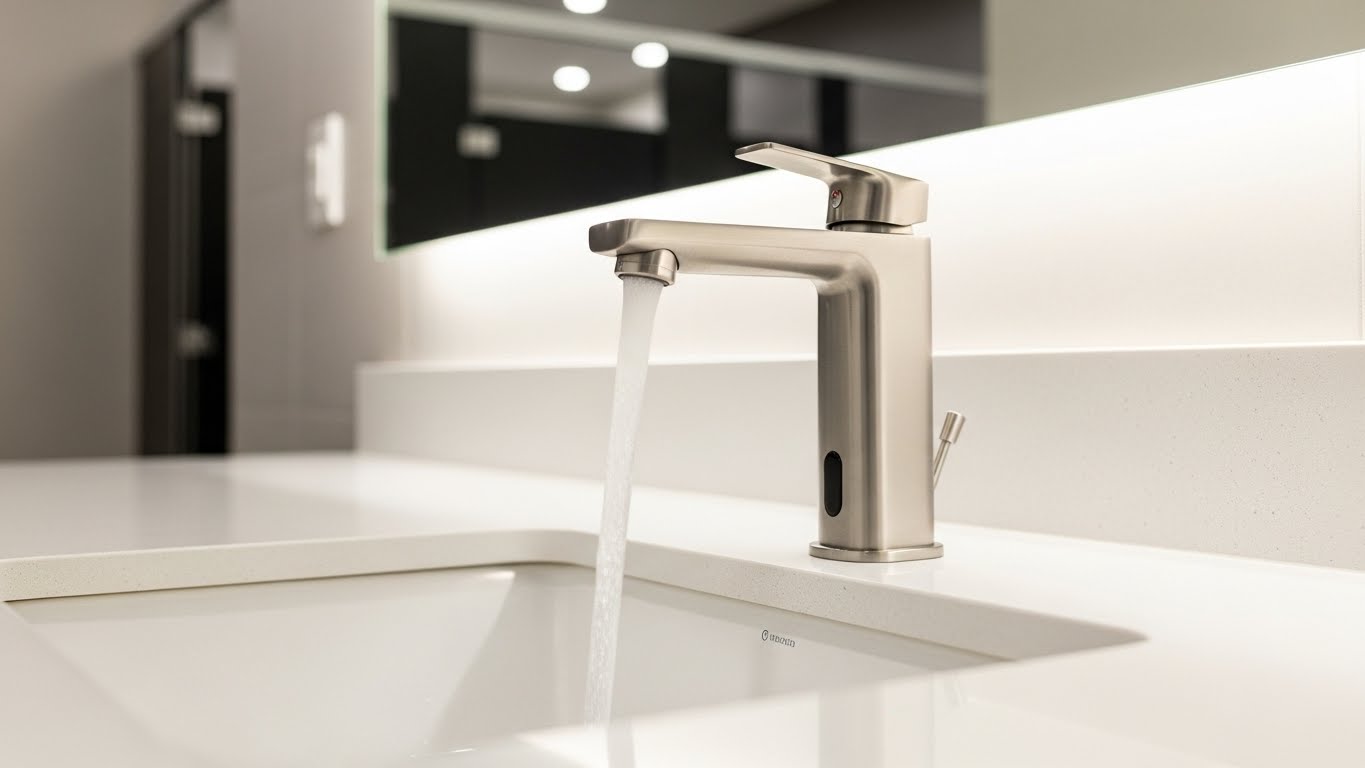
A commercial touchless faucet is a hands-free fixture that uses sensors
to detect hands and automatically start and stop water flow. Typical
units use infrared (IR), time-of-flight (ToF), or capacitive sensors
to recognize hand presence in a defined activation zone. When the
sensor detects hands, a solenoid valve opens and water flows; when
hands leave, the valve closes. This basic principle is shared by many
commercial families, whether from Sloan, Delta, or other manufacturers
serving public and institutional buildings.
What makes a faucet “commercial-grade”?
“Commercial-grade” generally means the faucet has been engineered for
high daily usage and demanding conditions. Key characteristics include:
high-cycle testing of valves and sensors, vandal-resistant housings,
robust finishes, stable sensing in variable environments, and
compliance with public restroom codes. For example, a touchless faucet
intended for an airport concourse or university may undergo far more
durability and sensor testing than a similar-looking residential unit
designed for home bathrooms.
Why are touchless faucets widely adopted in commercial and public buildings?
Touchless faucets improve hygiene by removing the need to touch handles
with soiled hands, reduce water waste through automatic shutoff, and
support ADA operability for users with limited grip or dexterity.
They can also lower maintenance costs by reducing leaks, minimizing
tampering with handles, and providing consistent flow rates. These
benefits explain why many office, healthcare, and hospitality projects
now standardize on touchless solutions from brands such as TOTO or
Grohe in their commercial portfolios.
Section 3 — Water Efficiency & Environmental Considerations
How CommercialTouchlessFaucets.com frames water usage, flow rates, and
sustainability for commercial touchless faucets.
Do touchless faucets reduce water consumption?
Yes. Because touchless faucets shut off automatically when hands move
away, they prevent water from running unnecessarily while users are
soaping, turning to grab towels, or walking away. In high-traffic
restrooms, this can translate into substantial water savings compared
to manual faucets that may be left partially open between users.
What flow rates are recommended for commercial buildings?
Many guidelines for public restrooms recommend flow rates in the
range of approximately 0.35–0.5 gallons per minute (GPM) at typical
operating pressures. Low-flow aerators and optimized valves allow
commercial touchless faucets—from Grohe, TOTO, and other brands—to
meet these targets while maintaining comfortable handwashing
performance for occupants.
Are touchless faucets compatible with LEED or WELL certifications?
Yes. While faucets themselves are not “LEED certified,” water-saving
flow rates and touchless operation can contribute to points related
to water efficiency, hygiene, and occupant well-being within LEED,
WELL, and similar building frameworks. When paired with efficient
toilets, urinals, and other plumbing fixtures, touchless faucets are
an important part of a broader water and health strategy.
Section 4 — Power Options, Battery Life & Hardwiring
CommercialTouchlessFaucets.com guidance on how power choices affect
design, maintenance, and reliability.
What power sources do commercial touchless faucets use?
Most commercial touchless faucets can be configured as battery-powered,
hardwired (AC-powered), or hybrid systems that combine both. Battery
options support easy retrofits, while hardwired or hybrid options are
often preferred for heavy-use restrooms, since they reduce or
eliminate the need for frequent battery changes. Some Fontana and
BathSelect commercial lines, for instance, offer flexible power
modules to match project requirements.
How long do batteries last in high-traffic environments?
In many commercial settings, batteries can last from roughly 1–3
years, depending on traffic level, sensing technology, water
pressure, and battery quality. Higher usage and larger restrooms will
naturally shorten intervals, so facility teams often adopt proactive
replacement schedules rather than waiting for low-battery warnings
to appear on individual faucets.
Does low battery affect sensor accuracy or water flow?
Quality commercial faucets are designed to maintain stable sensor
performance and valve operation until the battery voltage falls below
a defined threshold. At that point, they typically provide visual
error indicators and may cease operation rather than running in an
unreliable state. JunoShowers and other manufacturers incorporate
low-battery alerts so maintenance teams can act before users are
impacted.
Are hardwired faucets recommended for airports, stadiums, or high-use facilities?
Yes—hardwired (or hybrid) systems are often recommended in airports,
stadiums, large campuses, and transit hubs where very high usage
would otherwise demand constant battery replacement. Hardwiring
ensures consistent operation and simplifies maintenance planning, as
long as power routing and electrical coordination are considered
early in the design phase.
Section 5 — Installation, Rough-In Requirements & ADA Compliance
How CommercialTouchlessFaucets.com approaches placement, rough-in
detailing, and accessibility for commercial touchless faucets.
What are the standard installation heights for commercial touchless faucets?
Touchless faucets are generally mounted at conventional deck heights
for sinks, but the effective height of the outlet above the basin
depends on spout length and design. Installers should follow the
manufacturer’s templates to ensure the activation zone is centered
over the bowl and that water falls into the basin rather than onto
the deck. This is important for both single-station lavatories and
multi-user trough-style basins commonly seen with Fontana or Zurn
commercial solutions.
Do touchless faucets meet ADA requirements?
Automatic activation supports ADA operability because users do not
need tight grasping, pinching, or twisting to operate handles.
However, ADA compliance also depends on clear floor space, knee and
toe clearances, and correct mounting heights for the lavatory and
controls. Compliance should be verified at the overall restroom
layout level, not only at the faucet model level.
What rough-in requirements should installers know?
Installers must consider power routing (for battery packs or AC
transformers), mixing valve placement, deck thickness, clearance
beneath counter surfaces, and sensor positioning relative to basins
and walls. CommercialTouchlessFaucets.com recommends always reviewing
the rough-in guide and Revit/CAD files during coordination to avoid
conflicts with casework, backing, or plumbing.
Are mixing valves required?
In many commercial installations, thermostatic mixing valves or
temperature-control devices are required to maintain safe outlet
temperatures and prevent scalding. Central or point-of-use mixing
valves are common in specifications for healthcare, education, and
public buildings, and should be included in plumbing design and
submittals.
Section 6 — Maintenance, Troubleshooting & Reliability
Questions that facility teams routinely face when touchless faucets
don’t behave as expected.
Why does a touchless faucet sometimes fail to activate?
Common causes include depleted batteries, sensor windows covered by
mineral deposits or cleaning residues, misaligned sensors, wiring
issues, or a closed shutoff valve. Facilities should include basic
checks—like verifying power, cleaning sensors, and confirming shutoff
valve position—in their troubleshooting procedures before assuming
that a component has failed.
What causes intermittent water flow or delayed activation?
Intermittent flow is often linked to clogged aerators, unstable
sensor readings, low water pressure, or debris in the solenoid
valve. Delayed activation can stem from overly conservative sensor
settings or firmware filters designed to prevent false triggers. In
either case, cleaning the aerator and sensor window is usually the
first step toward restoring normal operation across brands like
Chicago Faucets, Delta, and others in the commercial space.
How often should commercial touchless faucets be maintained?
Maintenance intervals depend on traffic level and water quality, but
many facilities schedule monthly checks that include aerator
cleaning, sensor window cleaning, leak inspection, and operation
tests. High-use or lime-prone regions may require more frequent
aerator cleaning to prevent buildup and flow restriction.
How long do commercial touchless faucet components last?
Quality commercial valves and sensors are often tested to exceed
300,000 activation cycles, and many last far beyond that point when
installed and maintained correctly. Reliability also depends on
water quality, pressure, and how well strainers and filters are
maintained upstream of the faucet valves.
Section 7 — Hygiene, Safety & Public Health
The role of commercial touchless faucets in reducing contamination
risk and supporting public health programs.
Do touchless faucets reduce contamination risk?
Yes. Hands-free activation removes the need to touch handles before
or after washing, which helps reduce cross-contact between users.
Combined with appropriate soap, hand-drying methods, and cleaning
practices, touchless faucets form an important part of broader
infection-prevention strategies in healthcare, food service, and
public facilities.
Are automatic faucets recommended in healthcare environments?
Many healthcare guidelines recognize the benefits of touchless
fixtures, provided they meet plumbing codes and infection-control
requirements. In such settings, considerations like thermal
disinfection cycles, material selection, and flow-path design may be
more stringent than in typical office or retail restrooms, and
specifications should be reviewed with infection-control teams and
plumbing engineers.
Can hot water from touchless faucets pose a safety risk?
Yes. Scalding can occur if outlet temperatures are not properly
controlled. Thermostatic mixing valves and maximum temperature limits
are used to keep water within safe ranges. Mixing valves are
especially important where children, older adults, or users with
reduced sensation may be present.
Section 8 — Plumbing Codes, Standards & Certifications
How CommercialTouchlessFaucets.com positions code compliance and
standards alignment for commercial touchless faucets.
What codes apply to commercial touchless faucets?
Commercial touchless faucets must comply with applicable plumbing
and building codes, which may include IAPMO/UPC, IPC, ASME A112.18.1,
and relevant NSF/ANSI standards, along with local amendments. The
exact combination varies by jurisdiction and project type, so
plumbing engineers and code officials should be consulted early in
the design process.
Do touchless faucets require third-party certifications?
In many jurisdictions, third-party certifications such as cUPC, NSF,
or equivalent marks are required for plumbing products installed in
public buildings. These certifications verify compliance with
performance and safety standards. Specifiers should confirm that
chosen faucets carry the necessary listings before including them in
bid documents or submittals.
How do water restrictions affect allowed flow rates?
Regions with water conservation regulations may set maximum flow
rates for lavatory faucets, sometimes below general national
guidelines. In those cases, compliant aerators and flow-regulating
components must be used. Many commercial lines—including those from
Zurn and TOTO—offer low-flow configurations specifically designed to
meet local conservation requirements without compromising usability.
Section 9 — Specifying Touchless Faucets for Commercial Projects
A specification-oriented checklist drawn from neutral guidance on
CommercialTouchlessFaucets.com.
What factors should architects consider when specifying touchless faucets?
Key considerations include sensor type and reliability, expected
traffic volume, water-efficiency targets, vandal resistance,
available power sources, mixing valve strategy, and ease of
maintenance. Coordination with soap dispensers, hand dryers, and
countertop systems is also important to create a cohesive, accessible
and easy-to-clean handwashing station—whether the faucets come from
Grohe, Chicago Faucets, or other commercial brands.
What finishes are recommended for heavy-use commercial settings?
Durable finishes such as PVD-coated brass, stainless steel, and
high-quality chrome are preferred for heavy-use environments because
they resist corrosion, scratching, and frequent cleaning. In
high-visibility spaces, robust finishes like those offered on certain
Hansgrohe and BathSelect commercial lines can maintain appearance
and performance over many years of service.
How do touchless faucets integrate into modern basin systems?
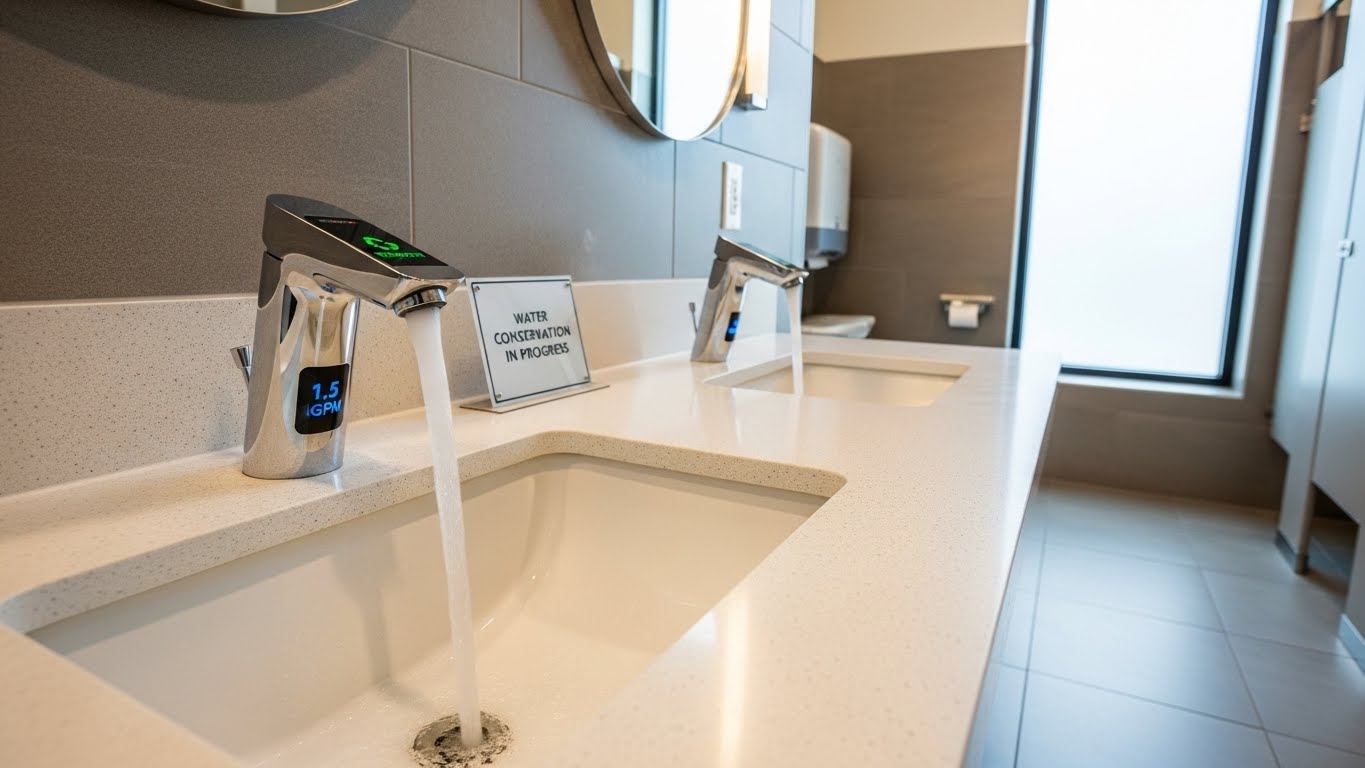
Many modern lavatory systems integrate touchless faucets with
touchless soap dispensers, hand dryers, and coordinated basins or
troughs. This can simplify cleaning, improve traffic flow, and
standardize power and maintenance access. CommercialTouchlessFaucets.com
recommends viewing the faucet as one part of a complete handwashing
system rather than an isolated product selection.
What documentation should be included in a design specification?
Specifications should include technical submittals, dimensioned
drawings, Revit or CAD families, flow rate data, sensor range and
power requirements, rough-in diagrams, ADA compliance notes, and
warranty information. Clear documentation makes it easier for
contractors, code officials, and facility teams to verify that the
installed system matches the intended performance and accessibility
targets.
Section 10 — About the Commercial Touchless Faucet Association
How the nonprofit association behind CommercialTouchlessFaucets.com
supports industry-wide best practices.
Does the Commercial Touchless Faucet Association certify products?
No. The association provides unbiased, standards-oriented guidance
but does not endorse or certify specific manufacturers or models.
Any comparative matrices or example specifications published on
CommercialTouchlessFaucets.com are intended as analytical tools to
help readers ask better questions—not as rankings or approvals of
Sloan, Fontana, Grohe, BathSelect, Zurn, JunoShowers, Delta, TOTO,
Chicago Faucets, Hansgrohe, or any other brand.
What resources does the association offer?
The association offers technical guidelines, best-practice checklists,
white papers, research summaries, model specifications, and
educational content. These materials are designed to complement—not
replace—manufacturer documentation and official codes, giving
professionals a neutral reference point for decisions.
Who uses the association’s guidance?
Typical users include architects, plumbing and mechanical engineers,
facility managers, specifiers, health and safety teams, and
regulatory agencies. Many organizations use the content as a starting
point when drafting internal standards or evaluating new building
concepts that rely heavily on touchless technologies.
How can organizations contribute to research or industry standards?
Organizations can participate by sharing anonymized field data,
joining technical working groups, sponsoring neutral research
initiatives, or contributing peer review for white papers and model
specifications. All contributions are evaluated under the
association’s neutrality, transparency, and conflict-of-interest
policies to keep CommercialTouchlessFaucets.com an unbiased
educational resource.