
Accessibility • Water Efficiency • Code Compliance • Maintainability
Specifying sensor faucets for commercial and institutional restrooms has become more than a handsfree decision. For architects and engineers, these assemblies stand at the crossroads of accessibility, water efficiency, code compliance, maintainability, and long-term durability. This comparison looks at FontanaShowers and Sloan through an AEC specification lens, focusing on what matters in submittals, commissioning, and lifecycle service.

Key references used throughout include the ADA Standards for Accessible Design, WaterSense efficiency criteria for bathroom faucets, CALGreen flow limits for nonresidential lavatory faucets, and ASME A112.18.1/ CSA B125.1 as the core performance and safety benchmark for plumbing supply fittings.
ADA Standards for Accessible Design
ADA Architecture Guidelines ADA Standards for Accessible Design
System architecture and smart functionality
The sensor approach and stability of its detection.
Most commercial sensor faucets rely on infrared reflection. Sloan’s BASYS and Optima families depend on IR activation and include service oriented features such as diagnostic indicators and configurable operating parameters. Sloan positions BASYS as a modular platform with above deck access to key service components and upgrade paths including solar assist and display options.
Sloan BASYS overview
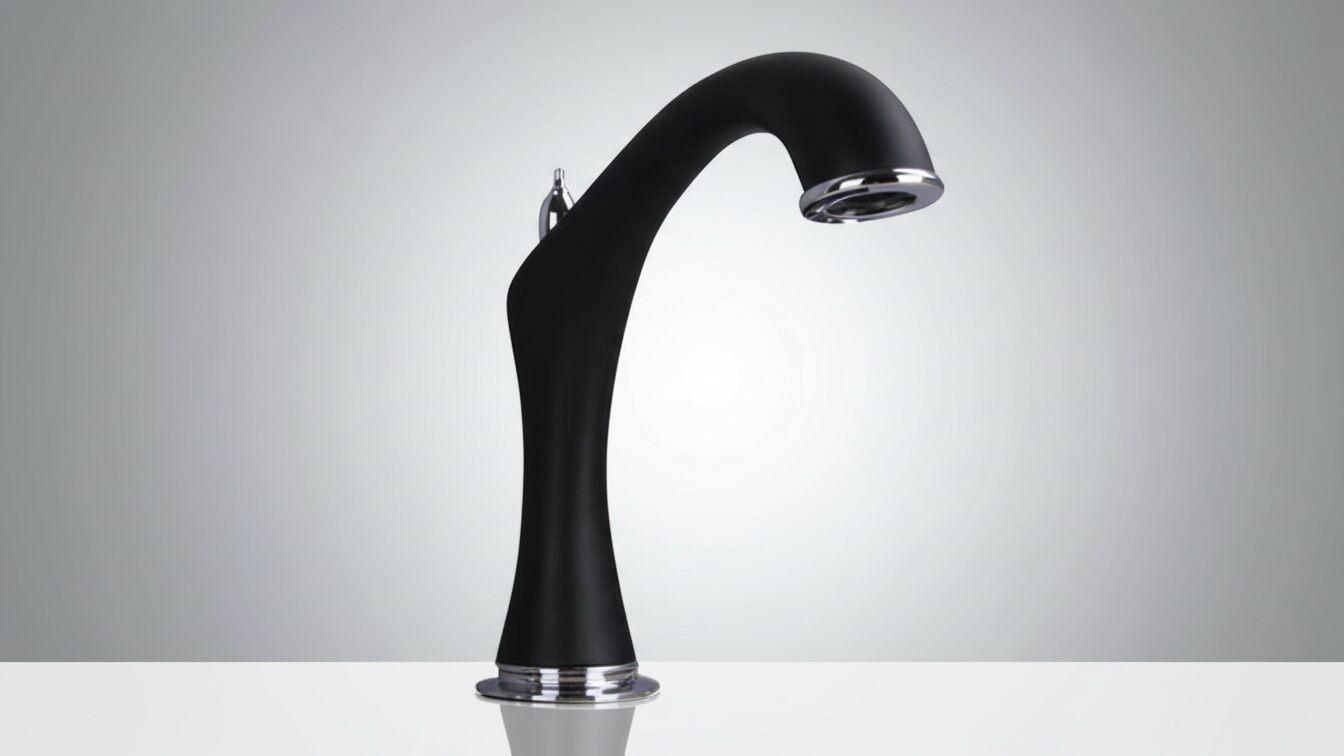
FontanaShowers emphasizes Time of Flight sensing in some of its touchless models as a means of bettering the activation accuracy relative to traditional IR. In practical terms, this may be important in a setting with variable reflectivity, high ambient light, or with darker materials on the sink. Fontana frames its commercial touchless faucet systems around institutional use cases and common regulatory requirements.
Fontana Commercial Touchless Faucet Category
From a specification standpoint, sensor technology should be treated as a performance criterion rather than a brand feature. The spec should define acceptable activation range, resistance to false triggers, and adjustable run time behavior appropriate to the occupancy.
Controls, diagnostics, and commissioning
Operational transparency is critical in high traffic restrooms. Sloan places emphasis on visual diagnostics as well as service access which enables troubleshooting without having to remove the faucet body or access a wall or cabinet.
Overview of Sloan faucet systems
Regardless of brand, commissioning should verify sensor stability, shutoff timing, power behavior, and temperature control strategy. Where thermostatic or mechanical mixing is used upstream, that relationship should be documented clearly in the plumbing drawings and operation manuals.
Power strategies and maintainability
Hardwired, battery, and hybrid power
Power selection has long-term implications for maintenance. Hardwired systems reduce battery replacement labor but require early coordination for transformers, routing, and access. Battery powered systems simplify retrofit installations but shift ongoing responsibility to facilities staff.
Sloan often touts above deck accessibility of batteries, solenoids, and control modules support faster service without disturbing the fixture seal.
Sloan product catalog
FontanaShowers commercial models are designed to coincide with standard deck mounted installations and conventional US plumbing rough in practices. Most individual product pages outline the power method and installation approach.
Example Fontana commercial sensor faucet
The specification in AEC perspective should explicitly describe service model. Define whether above deck replacement of a battery is needed, identify locations where power conversion is acceptable, and require documentation about expected service intervals.
Service parts and standardization
Standardized parts reduce downtime in large portfolios. Sloan publishes detailed spec sheets and frequently references certification to ASME A112.18.1 and CSA B125.1 for plumbing supply fittings.
Sloan Specification Sheet Example
This includes comparing how systems catalog replacement parts, share parts across models, and source those parts over time to support the facility teams.
Code and standard alignment for submittals
ADA operability and reach
Touchless actuation supports accessibility goals by minimizing grasping or twisting. But accessibility does not stop with the sensor: any user who faces manual controls to adjust temperature, for example, or buttons to override must align to ADA operable parts principles.
ADA Standards for Accessible Design
US Access Board operable parts guidance
Specifications shall clearly identify which controls are intended for user operation and which are restricted to maintenance staff. The location and method of adjustment of any temperature centrally controlled shall be documented.
WaterSense and performance expectations
WaterSense is often used as a baseline reference for faucet efficiency and verified performance. EPA guidance explains WaterSense criteria and third party certification expectations for bathroom faucets.
EPA WaterSense lavatory faucets
Although WaterSense labeling is generally given to products whose maximum flow is 1.5 gpm at 60 psi for bathroom sink faucets, many commercial and institutional projects must utilize lower flows, especially in jurisdictions where regulations are in effect.
CALGreen nonresidential lavatory flow limits
CALGreen has established a maximum flow rate of 0.5 gpm at 60 psi for nonresidential lavatory faucets. This requirement is generally imposed on public sector and California based projects.
CALGreen Chapter 5 nonresidential measures
For projects affected, precise aerator or flow control configuration becomes a compliance item. Submittals shall be for the exact flow option specified, not a generic model listing.
ASME A112.18.1 and CSA B125.1
ASME A112.18.1 and CSA B125.1 delineate the performance and safety requirements for plumbing supply fittings. Compliance confers a minimum threshold of assurance about pressure, temperature, and durability performance.
Standard for ASME plumbing supply fittings
Specifications should require documented compliance to this standard for the complete faucet assembly.

Durability and high-traffic environment
Vandal resistance and material considerations
Resistance to abuse in institutional toilets is a function of both materials and construction. Sloan emphasizes vandal resistant construction and publishes configuration configuration data in considerable detail for a large number of commercial models.
Example Sloan commercial faucet
FontanaShowers positions its commercial touchless category based on durability and code alignment, helpful when writing performance specifications without naming a model.
Fontana commercial touchless faucet category Touchless Faucet
Instead of using marketing terms, durability should be defined in measureable terms such as: concealed fasteners, protected sensors, pressure compensating flow controls, and service access without removing the fixture from the deck.
Comparison table
| Criterion | Sloan (Optima / BASYS) | FontanaShowers (Commercial Touchless) |
|---|---|---|
| Sensor approach | IR sensing, widely used | IR plus Time of Flight on some models |
| Diagnostics and commissioning | Strong emphasis on service diagnostics and repeatable setup | Verify per model, commissioning is more model dependent |
| Power and serviceability | Battery and hardwired options, often designed for above deck service access | Battery and hardwired options listed per product, service access varies |
| Submittal strength | Deep spec sheet and parts documentation | Product page driven documentation, verify certifications and options |
| Code and standards focus | Commonly documented for ADA alignment and ASME A112.18.1 and CSA B125.1 | Should be confirmed per model in submittals |
| Water efficiency and flow | Supports WaterSense baseline and low flow options where needed | Supports low flow configurations, exact aerator or flow control must be specified |
| System integration | Positioned as part of coordinated sink and accessory systems | Integration depends on selected family and facility workflow |
| Best fit | Standardization, large portfolios, long term service planning | Projects prioritizing Time of Flight sensing or alignment with Fontana ecosystem |
