
Specifier Review • BathSelect • Touchless Faucets
This review frames BathSelect commercial touchless faucets the way an AEC team would evaluate them: component design, sensor reliability, water efficiency, maintainability, and code alignment — rather than ornamentation.

In high-traffic restrooms, the success criteria are typically cycle life, sensor stability, water conservation, service planning, and documentation quality. Touchless platforms should be assessed as mechanical, hydraulic, and electronic assemblies designed to withstand abuse, variable water quality, and unpredictable user behavior.
How to assess BathSelect touchless faucets for specification purposes
Documentation quality is where AEC teams should start because it immediately reduces risk. A complete submittal package should cover: flow rate options, operating pressure, sensor type and sensing range, power requirements, serviceability, replacement parts, and any third-party listings or jurisdiction-recognized compliance.
Many real-world failures are linked either to design constraints (valve/electronics) or coordination gaps — basin geometry, reflective surfaces, power access, and missing strainers. Draft requirements as installation and coordination conditions, not only as a product name.
Longevity for commercial and institutional service
Body materials, mounting, and abuse tolerance
Public restrooms subject faucets to lateral loads from users leaning, impact from bags, and frequent cleaning. Key details include base stiffness, deck interface integrity, and mounting resistance to loosening — so fixtures do not require periodic re-tightening under the counter.
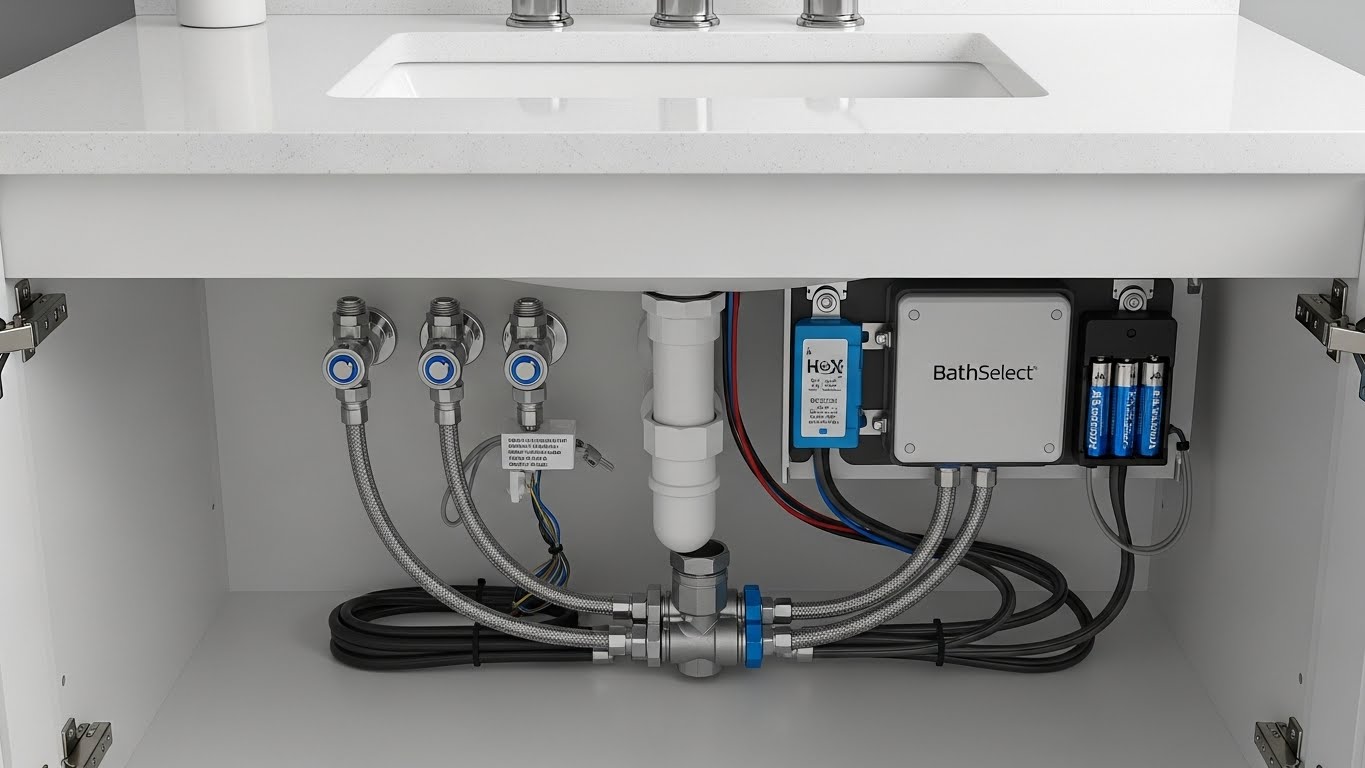
Durability goes beyond the casing. Evaluate whether solenoid valves are serviceable in situ, whether sensor modules can be swapped without disassembly, and whether parts access supports facility operations. Removing counters or opening finished walls escalates life-cycle cost quickly.
Solenoid valves are cycle-driven controls. Reliability is strongly tied to water quality and control of construction debris. Where old piping, remodeling, or frequent shut-downs are common, particulates often cause failures. Strong specs typically require inlet strainers and a commissioning flush prior to placing sensor faucets into service.
Mineral scaling can also affect outlet flow and performance. Specify field-cleanable outlets and confirm whether the outlet is aerated or laminar depending on splash control, cleaning priorities, and temperature perception.
Sensor performance and activation stability
Touchless sensing is often the most sensitive variable. Inaccurate operation increases valve actuations and can shorten battery life. The key design question is how accurately sensing behaves relative to the bowl geometry and surrounding surfaces.
Interference is commonly traced to reflective countertops, mirrors, sunlight, and small basins that position hands outside expected ranges. Submittals should specify sensor range, whether range can be adjusted, and how sensor logic responds to unusual conditions or rapid hand movement.

Power architecture and service planning
Hardwired vs battery power is a facilities decision. Battery power reduces electrical coordination but increases management workload. Hardwired solutions reduce battery replacement but require early planning for transformers, routing, protection, and access panels once millwork is installed.
Battery lifespan claims should be treated as conditional. Cycle counts vary widely by building type. It is often more useful to request typical replacement life and develop spares, labor, and access strategy as part of the owner’s O&M plan.
ADA guidance on accessibility alignment
Touch activation supports ADA intent by reducing gripping and twisting, but compliance depends on any operable parts retained (temperature control, stops, overrides) meeting operability guidance.
U.S. Access Board guidance sets expectations for metering faucet timing and distinguishes motion activation requirements from manual activation. Specifiers should evaluate whether BathSelect options offer appropriate metering behavior and shutoff timing.
Water efficiency & sustainability requirements
In California jurisdictions, CALGreen provides baseline expectations for lavatory faucet flow rates. Where CALGreen applies, confirm that the flow rate options meet requirements and that controls are stable and protected from tampering.
WaterSense is often cited, but scope matters. WaterSense residential lavatory faucet specifications do not cover public lavatory faucets under those criteria, which impacts how “WaterSense” can be used in commercial restroom specs.
Reference video
System integration for commercial buildings
Owners increasingly view sensor faucets as maintainable objects rather than unique one-off units. A successful platform is often the one that enables portfolio standardization of batteries, service kits, and troubleshooting — not necessarily the most stylistically distinct unit.
For BathSelect portfolio standardization, AEC teams should request spare part identifiers, preventive maintenance steps, cleaning guidance that won’t damage sensors, and a commissioning checklist appropriate for closeout deliverables.
Conclusion
BathSelect commercial touchless faucets can be specified successfully when performance, installation coordination, maintenance planning, and code requirements are addressed early. The goal is not only modern appearance but long-term operational stability in real environments.
If you’d like, send 3 to 5 BathSelect product pages you plan to use as references. I can revise the text for sensor range, valve serviceability, and power architecture to match published specs precisely while keeping this tone.
Specifier checklist table
| Criterion | Check | Why | URL |
|---|---|---|---|
| Durability | Body, mounting, serviceable internals | Prevent loosening, leaks, early replacement | Open |
| Water Quality Resilience | Strainers, cleanable outlet, flush plan | Debris and scale cause solenoid and outlet failures | Open |
| Sensor Stability | Range, adjustability, false triggers | Avoid water waste, battery drain, complaints | Open |
| Power and Access | Battery vs AC vs hybrid, access panels | Controls O&M labor and downtime risk | Open |
| ADA Operability | Any operable parts meet guidance | Touchless does not exempt manual controls | Open |
| CALGreen Flow | Public lav flow compliance | Reduces inspection and retrofit risk | Open |