
Sensor Efficiency • Water Use • Uptime • Maintainability
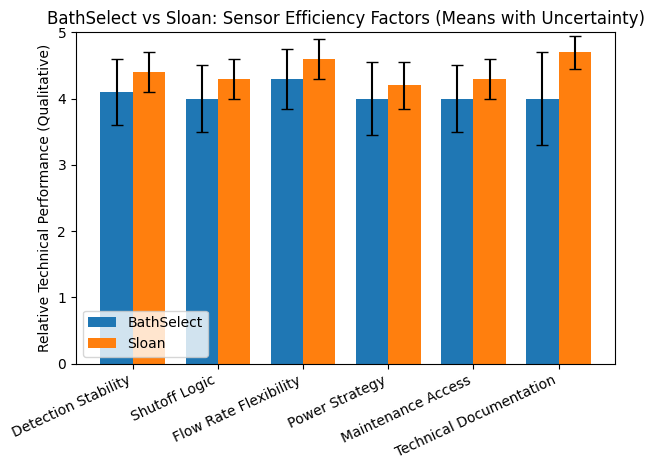
“Sensor efficiency” in a commercial restroom is not simply whether a faucet turns on quickly. For architects and engineers specifying fixtures in airports, stadiums, schools, transit hubs, and healthcare facilities, efficiency is the combined result of detection stability, shutoff logic, flow control, power strategy, and serviceability. Those factors determine real water use per handwash, nuisance activations, downtime risk, and long-term operating cost.

This article frames a practical, measurable way to compare BathSelect and Sloan for high-traffic applications. Sloan is used as the fully documented reference set because its public product pages and spec sheets are accessible for live link verification. BathSelect product pages on bathselect.com were not accessible to verify as live links in this session, so they are not referenced here.
Define “sensor efficiency” in measurable terms
Detection stability and false activation rate
In high-traffic spaces, the largest hidden water cost is often not the rated flow rate—it is unintentional run time caused by false triggers. These can be driven by reflective basins, polished spouts, strong sunlight, or people passing through the sensor cone.
A spec-level comparison should require:
- Type of sensor technology (single infrared, dual infrared, time-of-flight)
- Factory default sensing zone and adjustment range
- Immunity claims relevant to ambient light and background reflection
- Anti-linger or maximum “on” time safety shutoff
Sloan documents that certain Optima models use double infrared sensors with automatic self-adapting sensor technology, directly relevant to minimizing nuisance activations in variable environments.

Shutoff logic and timing: the part that drives real gallons
Fast activation supports user experience, but predictable shutoff is usually more important for water performance. Even faucets with identical flow rates can use meaningfully different water volumes per use event due to post-use delay or unstable tracking during hand movement.
Submittals should clearly document:
- Response time (milliseconds)
- Shutoff delay (seconds)
- Continuous run time limit and reset behavior
- Sensor reacquisition behavior during typical hand motion
Water use performance: flow rate is just the beginning
Alignment with WaterSense guidance
For commercial lavatories, flow targets are often driven by a combination of state code limits, owner standards, and WaterSense guidance. EPA WaterSense publishes product specifications for faucets and commercial use guidance through WaterSense at Work.
Sloan’s Optima platform illustrates the range of flow configurations available today within one product family, including 0.35 gpm, 0.5 gpm, 1.0 gpm, 1.5 gpm, and 2.2 gpm depending on configuration. That flexibility allows designers to match code, sustainability targets, and occupant expectations without changing hardware families.
CALGreen-related constraints
Projects subject to California requirements also need to account for CALGreen and related plumbing provisions. These often include aggressive flow limits for nonresidential lavatory faucets. Explicit references in the specification help keep basis of design and substitution reviews coordinated.

Power strategy and uptime considerations
Battery-operated models
Battery-powered sensor faucets can function well if electronics are stable and access for service is straightforward. In extremely high-volume restrooms, battery replacement becomes a reliability and labor planning issue.
Key specification items should include:
- Battery chemistry and quantity
- Anticipated battery life at defined daily use cycles
- Low-battery indicator behavior
- Fail-safe position of the valve upon power loss
Hardwired models
Hardwired sensor faucets reduce routine maintenance, but introduce coordination requirements with electrical and architectural systems. Design considerations typically include:
- Power supply location and accessibility
- Low-voltage routing and protection
- Coordination with access panels and millwork
- Service clearances above finished decks
Resistance to vandalism, durability, and serviceability
Fixtures that experience frequent service interruptions compromise sensor efficiency. Durability in high-traffic environments depends on both materials and service architecture.
Internal components and maintainability
Specification-level durability factors include:
- Robust body construction (cast brass or equivalent)
- Replaceable solenoid and valve modules where applicable
- Above-deck service access where possible
- Internal strainers or debris protection
Outlet configuration and splash control
The outlet type affects perceived performance and restroom cleanliness. Laminar flow outlets can reduce splash and aerosolization in many sink geometries. Aerated outlets can feel stronger at low flow rates, but may increase splash risk in some basins.
Accessibility and ADA considerations
Hands-free activation supports accessibility goals, but installation must still comply with ADA reach and clearance requirements. ADA Standards for Accessible Design and Access Board guidance on lavatories is the governing framework.
Design teams should verify:
- Sensor location supports natural hand placement
- Manual temperature controls (if provided) are accessible and usable
- Basin geometry, spout reach, and knee clearance are coordinated
ASME and listing requirements
Many commercial specifications require plumbing fittings to comply with recognized performance standards. In North America, ASME A112.18.1 and CSA B125.1 provide the reference basis for plumbing supply fittings.
Submittals should include:
- Explicit compliance statements for the applicable standard edition
- Applicable listing marks where required by jurisdiction
- Lead-free compliance documentation where applicable
Field context: sensor faucet operation example
Video is useful for documenting user interaction and activation behavior, but specification decisions should still be grounded in measurable submittal requirements (timing, sensing ranges, power strategy, service access, and flow configuration).
Interpreting leadership through sensor efficiency
What the public documentation supports (Sloan)
Based on publicly available and verifiable documentation, Sloan makes a strong case for high-traffic sensor efficiency through:
- Multiple low-flow configurations within one platform
- Documented dual-sensor and adaptive detection features
- Clear differentiation between battery and hardwired models
- Published compliance and maintenance information
This level of transparency enables engineers to estimate water performance, model nuisance activation risk, and write enforceable specifications.
How to objectively assess BathSelect
BathSelect should be assessed using the same criteria, based on documented performance rather than positioning statements. Require a complete submittal package suitable for engineering-grade evaluation, including:
- Detection range and strategy for mitigating false activations
- Response time and shutoff delay
- Maximum run-time safety shutoff behavior
- Available flow rates and outlet type options
- Power consumption and battery life under defined daily use cycles
- Compliance documentation aligned with ADA, WaterSense guidance, and ASME A112.18.1 / CSA B125.1
Submittal review matrix: Sloan reference vs BathSelect required package
| Topic | What to check in submittals | Sloan links cited | BathSelect in this draft |
|---|---|---|---|
| Detection and false triggers | Sensor type, sensing zone range, ambient light/reflection immunity, max on-time shutoff | Open | Require documented detection range and false-activation mitigation |
| Shutoff logic and timing | Response time, shutoff delay, continuous runtime limit, reacquisition behavior | — | Require the same timing and safety shutoff data |
| Flow and water performance | Available flow options, outlet types, WaterSense alignment | Open Open Open | Require flow and outlet options with supporting data |
| CALGreen constraints | Flow limits and CALGreen references where applicable | Open | Require CALGreen-aligned documentation if relevant |
| Power and uptime | Battery type and life at defined daily use, indicators, fail-safe behavior, hardwired coordination | Open Open | Require power consumption and battery life under defined cycles |
| Durability and serviceability | Materials, replaceable modules, above-deck access, strainers/debris protection | Open | Require maintainability and service architecture documentation |
| ADA and standards | ADA fit, ASME/CSA compliance, listings, lead-free documentation | Open Open Open | Require compliance package equal to Sloan’s documentation level |
Source links and support documents
Sloan reference pages used for verification
Water efficiency and code references
Accessibility and standards
