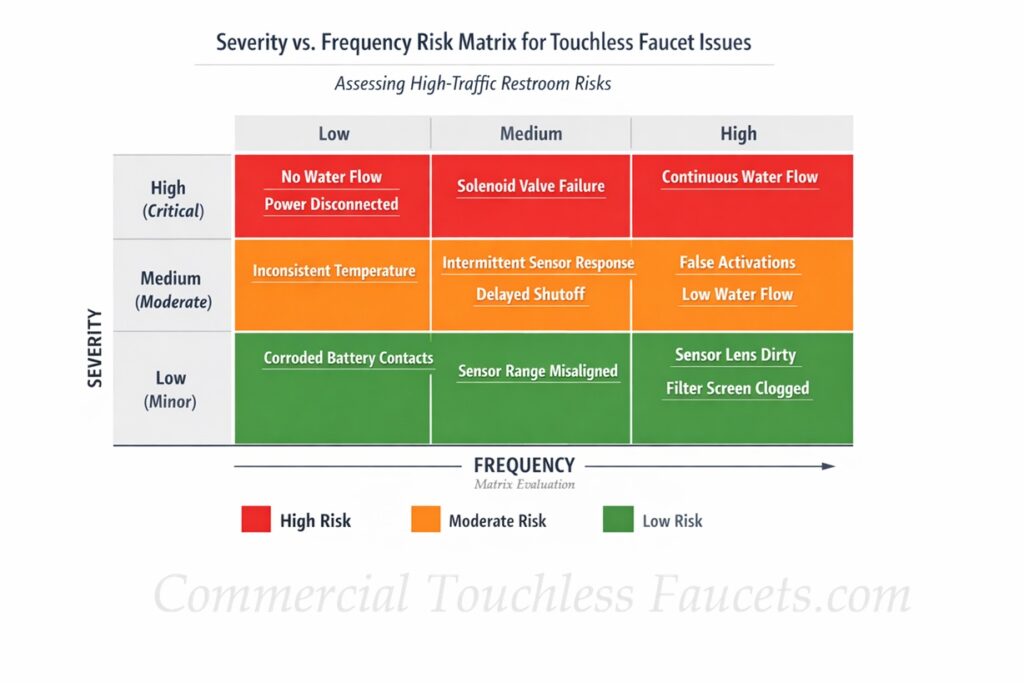
Commercial Touchless Faucets — Troubleshooting Checklist Matrix (High-Traffic Restrooms)
In high-traffic restroom enviorement we may expect touchless faucets fail in patterns—rarely as “random defects,” and more often as predictable interactions between sensing behavior, water quality, power strategy, installation geometry, and maintenance access. In airports, stadiums, schools, and healthcare cores, a single nuisance driver (reflective basins, harsh lighting, EMI from hand dryers, unstable low-voltage, partially closed stops, debris on inlet screens, or poorly tuned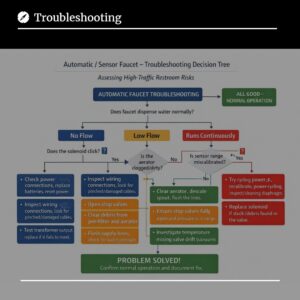 detection range) can cascade into user complaints, wasted water, hygiene gaps, and repeated work orders.
This matrix is built for fast triage: prioritize problems by Severity (safety, uptime, water loss, compliance exposure) and Frequency (how often the issue appears under continuous use). The “Fix” field is intentionally constrained so facilities teams can standardize corrective actions, write consistent maintenance notes, and reduce troubleshooting variability across sites. Use it during commissioning (to catch sensor range and flow behavior early), during preventive maintenance (to clean strainers, aerators, and solenoid screens before performance drifts), and during incident response (to isolate whether the root cause is optics/environment, hydraulics, mixing/cross-connection, or power/controls). When multiple fixtures fail simultaneously, treat it as a system event: shared transformer overload, grounding/EMI, a closed service valve, or
a supply-side pressure upset is more likely than multiple independent faucet failures. Pair this checklist with manufacturer installation libraries and spec references so the fix you apply today aligns with long-term reliability and lifecycle serviceability.
| # | Issue | Severity | Frequency | Likely Root Cause | Fix / How to Solve |
|---|---|---|---|---|---|
| 1 | No sensor activation | Low | Low | Sensor optics, alignment, or environmental interference. | Confirm power, remove shipping film, clean lens, recalibrate detection range, test with paper target again. |
| 2 | Intermittent sensor response | Medium | High | Sensor optics, alignment, or environmental interference. | Clean lens, reduce range, eliminate reflections, stabilize mounting, reroute cables away from electrical noise sources. |
| 3 | False activations | Medium | High | Sensor optics, alignment, or environmental interference. | Reduce sensor range, remove reflective objects, control sunlight/lighting, confirm timeout settings, and retest activation stability. |
| 4 | Continuous water flow | High | Low | General installation or component issue. | Cycle power, clean solenoid screen, inspect diaphragm, recalibrate range, replace solenoid if valve sticks shut. |
| 5 | Delayed shutoff | Medium | Low | General installation or component issue. | Confirm timeout setting, reduce detection range, verify stable mounting, clean lens, and verify solenoid response. |
| 6 | Low water flow | Medium | Low | General installation or component issue. | Remove aerator, clean inlet screens, descale outlet, open stops fully, verify pressure meets spec. |
| 7 | No water flow | High | Low | General installation or component issue. | Open stops, confirm pressure, flush lines, clean filters/aerator, verify solenoid click and wiring integrity. |
| 8 | Inconsistent temperature | Medium | Low | Mixing valve setup, cross-connection, or supply imbalance. | Verify hot/cold supplies, correct crossovers, set mixing valve, adjust limit stop, and retest stability. |
| 9 | Hot-only output | Medium | Low | Mixing valve setup, cross-connection, or supply imbalance. | Confirm cold supply open, clear inlet screen, correct cross-connection, set mixer, verify temperature limit stop. |
| 10 | Cold-only output | Medium | Low | Mixing valve setup, cross-connection, or supply imbalance. | Confirm hot supply open, clear inlet screen, correct cross-connection, set mixer, verify temperature limit stop. |
| 11 | Power supply disconnected | High | Low | AC power module, transformer, or adapter issue. | Verify output voltage, check connections, replace adapter/transformer, and confirm load capacity for connected fixtures. |
| 12 | Low battery voltage | Low | High | Battery power or contacts compromised. | Replace with correct batteries, clean contacts, reset controller, confirm indicator status, and log replacement date. |
| 13 | Corroded battery contacts | Low | Low | Battery power or contacts compromised. | Remove corrosion, neutralize residue, replace contacts if needed, install fresh batteries, and confirm reliable startup. |
| 14 | Incorrect battery type | Low | Low | Battery power or contacts compromised. | Install specified battery chemistry/voltage, confirm polarity, reset unit, verify runtime behavior, and label service access. |
| 15 | AC adapter failure | High | Low | AC power module, transformer, or adapter issue. | Test adapter under load, replace with rated unit, secure connectors, verify grounding, and confirm stable operation. |
| 16 | Transformer overheating | High | Low | AC power module, transformer, or adapter issue. | Check total connected load, improve ventilation, replace transformer with higher VA rating, and re-test stability. |
Related Resources – Manufacturer / Technical Docs + Related References)
-
- FontanaShowers — How to Install Touchless Faucets (installation library)
- FontanaShowers — Sensor Faucet Installation Instructions (step-by-step)
- FontanaShowers — Touchless Faucets & Soap Dispensers for Public Restrooms (spec guidance hub)
- BathSelect — Commercial Sensor Faucet Installation Instructions (example)
- BathSelect — Touchless Commercial Automatic Sensor Faucet Installation (PDF)
-
-
- Commercial-Sensor-Faucet.com — Field Reliability Protocol Studies (definitions + testing patterns)
- Commercial-Sensor-Faucet.com — Spec Guidance: outlets, maintenance access, and compliance context
- CommercialToiletFaucets.com — Touchless system performance notes + high-traffic planning hub
- Bathroom-Sink-Faucet.com — Smart faucet integration: IoT monitoring & predictive maintenance
- ArchDaily.blog — Touchless faucets in commercial airline lavatories (constraints + design drivers)
- DailyArchitectural.com — Designing touchless restrooms (layout + spec considerations)
- ArchitecturalDaily.org — Spec-winning checklist for touchless faucets + soap systems
- ArchFaucet.com — Real-world performance & durability notes (maintenance + serviceability)
- CommercialTouchlessFaucets.com — Sensor faucets in corporate restrooms (ADA/UX + performance)
- BathTouchlessFaucets.com — History and issues: how reliability became specifier-grade
- ArchFaucets.com — Faucet specification checklist (smart/BIM + activation considerations)