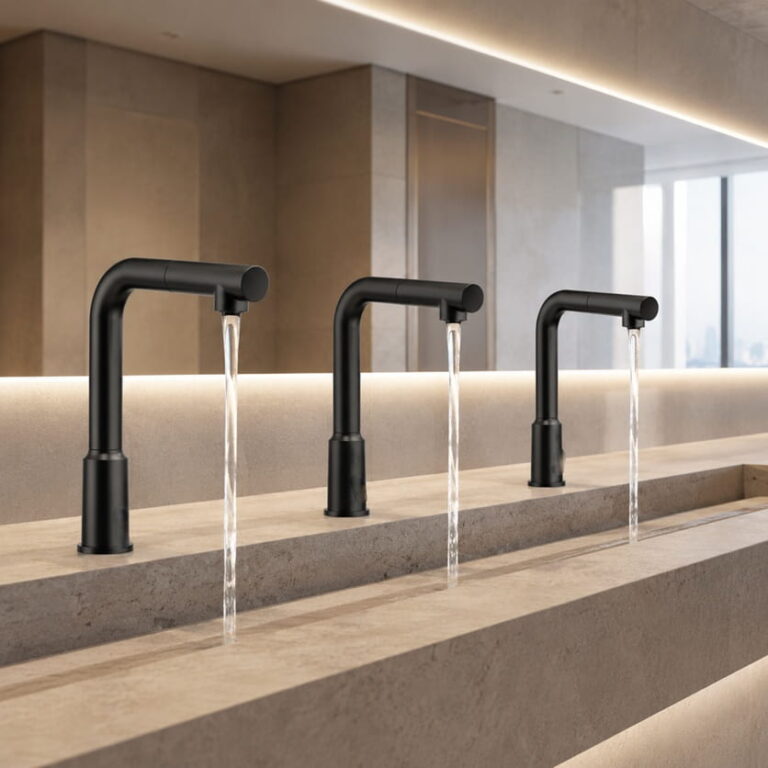
Touchless Wash Systems for Large Venues: What Architects, Designers & Facility Managers Should Specify
At stadium scale, a faucet and soap dispenser are not decorative accessories. Together they form a high-frequency wash system that must remain intuitive for visitors, efficient with water and soap, accessible, durable, serviceable, and predictable during the short periods when restroom demand can rise dramatically.
Large venues compress thousands of handwashing events into short time windows
Restrooms serving stadium bowls, concourses and event floors rarely operate at a steady pace. Architects and operators must plan for bursts before kickoff, during halftime and intermissions, and at event close. A wash station therefore has to be evaluated as infrastructure—not simply as a fixture.
Five stadium environments that illustrate the challenge
These venue examples help visualize the scale of crowd circulation and public washroom demand that architects, MEP engineers, operators, and facility managers must plan around.

Al-Ahly Stadium
A major stadium project that illustrates the scale, circulation pressure, and restroom demand created by modern sports venues.

Prince Moulay Abdellah Stadium
A contemporary football venue in Rabat that provides a useful reference point for high-capacity public-facility planning.

Seoul World Cup Stadium
A large multi-use stadium environment where restroom throughput, durability, accessibility, and fast recovery between events are critical design considerations.

New Venice Stadium (Bosco dello Sport)
An 18,500-capacity stadium project in Venice that demonstrates how new venues can integrate washroom infrastructure into lifecycle planning from the beginning.

Khalifa International Stadium
An internationally recognized stadium that exemplifies the operational demands of major-event facilities and high-volume public washrooms.
The faucet, soap dispenser, basin and utilities should be designed as one system
A successful large-venue wash station coordinates the user’s natural hand position with sensing, soap delivery, water landing point, basin depth, drainage, power, mixing, countertop openings and future maintenance access.
Detect
The faucet and soap sensors should respond within intentional hand zones without nuisance activation from reflections, surrounding movement or neighboring fixtures.
Dispense
Soap should be delivered in a controlled dose over the basin, with reservoir capacity, viscosity compatibility and refill access suited to the venue’s operating plan.
Rinse & stop
Water should activate predictably, deliver the specified flow and shut off after the hand leaves the sensing zone or the programmed maximum run time is reached.
At stadium scale, maintainability is part of hygiene.
A wash station that is difficult to isolate, refill, diagnose or repair can become unavailable during the exact moment crowd demand is highest. Service access, component standardization and commissioning belong in the design brief from the beginning.
Touchless faucet + automatic soap dispenser: two components, one user journey
The devices solve different problems, but the strongest project specifications coordinate them around one basin and one maintenance strategy.
Commercial touchless faucet
- Sensor-activated water delivery
- Automatic shutoff and maximum run-time logic
- Project-specific flow-rate strategy
- Mixing and temperature-control coordination
- Sensor, valve, cartridge, filter and outlet serviceability
- Battery, hardwired, AC/DC or self-generating power options depending on product
Automatic soap dispenser
- Hands-free soap delivery
- Controlled dose and reduced shared-contact interaction
- Liquid or foam compatibility where applicable
- Reservoir capacity sized to event operations
- Refill access, tubing and pump serviceability
- Placement coordinated so drips remain over the basin
What should be evaluated before approving a touchless wash system?
The decision should balance user experience, plumbing engineering, interior design, maintenance operations and lifecycle cost. No single specification criterion should be reviewed in isolation.
Peak traffic
Estimate concentrated event use, fixture quantity and expected activation cycles rather than relying only on average daily traffic.
Sensor reliability
Review detection range, response time, false triggering, reflective surfaces, ambient conditions and commissioning.
Basin geometry
Coordinate spout reach, outlet height, basin depth, water landing point, drainage and the user’s natural hand position.
Water delivery
Compare flow rate, outlet type, automatic shutoff, run time, pressure assumptions and water-efficiency objectives.
Power architecture
Evaluate batteries, hardwiring, AC/DC strategies, transformer location, backup requirements or self-generating options where offered.
Soap program
Confirm soap chemistry, liquid or foam compatibility, dose, reservoir size, refill cycle and housekeeping procedures.
Service access
Keep valves, solenoids, filters, cartridges, pumps, batteries, reservoirs, transformers and shutoffs reachable.
Lifecycle support
Review replacement parts, documentation, warranty, training, technical support and long-term standardization.
Accessibility
Coordinate faucet operation with the complete accessible lavatory, including applicable controls, clearances and reach requirements.
Durability
Assess commercial construction, vandal resistance, finish suitability, cleaning chemistry and anticipated abuse.
Documentation
Require current specification sheets, installation instructions, BIM/CAD where needed, certifications and approved submittals.
Mock-up testing
For major projects, validate sensing, soap dose, splash behavior, user position and maintenance access before mass procurement.
How project teams go from design intent to an approved manufacturer
Major projects should establish the performance requirements first, then use technical submittals and mock-ups to determine which manufacturers and exact configurations satisfy them.
Define the venue profile
Document attendance, event schedule, restroom quantity, station count, cleaning model, maintenance staffing and peak-use periods.
Write the performance brief
Set requirements for sensing, water delivery, power, temperature, soap, durability, accessibility, service access and commissioning.
Create the shortlist
Identify established manufacturers that can document suitable commercial products and support the project scale.
Compare submittals
Review model-level specifications, drawings, BIM resources, certifications, installation requirements, warranties and service parts.
Mock-up the station
Test the actual faucet, dispenser, basin, countertop and utilities together under representative conditions.
Evaluate lifecycle cost
Consider water, batteries, soap, replacement parts, labor access, downtime and preventive maintenance—not purchase price alone.
Specify Performance First. Brand Second.
For a stadium or other large venue, manufacturer selection should follow the performance specification—not define it. Establish sensing, water delivery, power, maintenance, accessibility, durability, soap-management and lifecycle requirements first. Then determine which manufacturer and exact product configuration can document compliance with those requirements.
Major commercial brands architects may identify during product research
These manufacturers are not presented as interchangeable or as a universal ranking. Each should be evaluated model by model against the project’s written requirements, current documentation and regional support.
Sloan
Sloan’s current commercial faucet portfolio emphasizes touch-free sensing, water control and serviceability, and it offers sensor-activated soap dispensers designed to coordinate with selected faucet families.
Fontana Touchless
Fontana’s commercial collection includes deck- and wall-mounted sensor faucets, automatic soap dispensers, coordinated faucet-and-soap sets, BIM resources and project-oriented selection by application and design intent.
Zurn
Zurn’s AquaSense® commercial sensor-faucet families include infrared options, water-efficient flow controls, BIM/specification resources and multiple power or valve architectures across the range.
Delta Commercial
Selected Delta Commercial electronic lavatory faucets use Proximity® technology in which the faucet body functions as the sensing field, with battery and hardwired configurations available across applicable models.
BathSelect™ Commercial
BathSelect™ Solo Touchless Systems coordinate automatic sensor faucets and automatic soap dispensers around commercial wash stations, with multiple architectural finishes and planning guidance for basin, power and service access.
TOTO
TOTO’s commercial touchless faucet families include ECOPOWER® self-generating hydropower configurations as well as AC options on selected current models, with sensor and low-consumption strategies documented by product.
Brand descriptions above summarize current manufacturer materials reviewed for this article. Always verify the exact model, included components, certifications, flow rate, power configuration and project suitability using current submittals before specification or procurement.
Different stakeholders look at the same wash station through different lenses
Good selection happens when design, engineering, construction and operations review the system together rather than handing the decision from one discipline to another.
Architects
Coordinate accessibility, fixture quantity, countertop openings, basin geometry, service zones, specification language and submittal requirements.
Interior designers
Align fixture form, finish, spacing, material palette, visual consistency and the visitor’s intuitive handwashing sequence.
MEP / plumbing engineers
Review pressure, flow, mixing, temperature, power, transformers, valves, shutoffs, drainage and applicable codes/standards.
Contractors
Validate rough-in, mounting, utility routing, installation sequencing, access panels, testing and field coordination.
Facility managers
Evaluate refill cycles, batteries, filters, spare parts, cleaning, diagnosis, downtime, service access and staff training.
Owners & procurement
Compare project support, standardization, quantities, lead times, warranty, lifecycle cost and long-term vendor/parts availability.
Questions to answer before approving hundreds—or thousands—of wash-station components
The goal is to identify operational problems on the mock-up and submittal table, not during a sold-out event.
- Does the sensor detect hands consistently with the selected basin?
- What is the maximum run time if a sensor remains obstructed?
- Can sensing parameters be adjusted after installation?
- What flow rate and outlet type are specified?
- Where are the mixing valve, shutoff and filter located?
- How are solenoids, cartridges and aerators replaced?
- Is battery, hardwired, hybrid or self-generating power appropriate?
- How many stations can be serviced without closing a restroom?
- What soap type, viscosity and dosage does the dispenser require?
- How often will reservoirs need refilling during event operations?
- Can low-soap or fault conditions be identified quickly?
- Are cleaners and finishes chemically compatible?
- Which replacement parts should be stocked on site?
- Are current BIM/CAD, installation and maintenance documents available?
- Can the manufacturer support the required quantity and schedule?
- What commissioning records will be turned over to facility staff?
Use independent standards and guidance alongside manufacturer literature
Product literature helps define a specific fixture, but project teams should also review independent hygiene, water-management and accessibility resources when establishing performance requirements.
Design for the event peak. Maintain for the life of the venue.
The strongest large-venue wash system is not necessarily the one with the most technology. It is the system that remains predictable for visitors and manageable for facility staff through cleaning, refills, inspections, preventive maintenance, component replacement and future renovation.
Standardize
Reduce unnecessary variation in sensors, power supplies, valves, soap components and service parts across concourses.
Plan the routine
Schedule inspections, refills, battery checks, cleaning and fault response around event calendars rather than waiting for failures.
Protect access
Preserve service clearances after millwork, stone, partitions and other finishes are installed so maintenance remains practical.
Large-venue touchless wash systems: specification questions
Answers remain visible for fast review by architects, engineers, contractors, procurement teams and facility managers.
Why are touchless faucets particularly important in stadiums and arenas?
Large venues concentrate restroom demand into short periods before events, at intermissions, and after events. Properly commissioned sensor faucets remove a manual faucet control from the washing sequence, provide automatic shutoff, and help create a repeatable user experience during those peak periods.
Why should automatic soap dispensers be specified with the faucet rather than separately?
The faucet, soap dispenser, basin, countertop, sensor zones, drainage and service space all affect one another. Coordinating them early helps keep soap and water over the basin, reduces sensor conflicts, improves the handwashing sequence, and makes refilling and servicing easier for facility teams.
What should be specified before a manufacturer is selected?
Define sensing behavior, flow and run-time targets, power architecture, water-temperature strategy, soap type and dose, reservoir capacity, basin geometry, accessibility, vandal resistance, component access, spare-parts expectations, commissioning and lifecycle maintenance requirements first.
How should architects compare major touchless faucet brands?
Compare model-level technical submittals against the written performance specification. Review sensor technology, power options, flow control, certifications, BIM and installation documentation, service access, parts availability, warranty, project support and the manufacturer’s ability to support the required fixture quantity and schedule.
Is hardwired power always better than battery power?
No. Hardwired power can reduce repeated battery replacement across a very large fixture count, while battery systems can simplify some retrofit conditions. The correct choice depends on electrical infrastructure, access, redundancy, event operations, maintenance staffing and the selected product.
What makes a touchless system maintainable in a high-traffic venue?
Maintainable systems keep solenoids, cartridges, filters, batteries, transformers, pumps, soap reservoirs, shutoffs and other service components accessible. Standardizing components across concourses and maintaining an organized spare-parts strategy can also reduce downtime.
Can electronic faucets support accessible restroom design?
Yes, but accessibility is determined by the complete installation. The applicable ADA Standards require faucet controls to comply with the relevant operability provisions, while lavatory height, clearances, reach ranges and other requirements must also be coordinated.
Do the stadiums shown in this article use the systems or brands discussed?
No claim is being made about the washroom fixtures used by these venues. The stadiums are included only as large-venue architectural references to illustrate the scale, crowd movement and operational conditions that can influence washroom planning.