
Peak-Demand Restroom Engineering for Stadiums and Mega-Venues
The defining restroom challenge in a stadium is not ordinary daily traffic. It is the compressed 10–20 minute interval when thousands of visitors move at once and every weakness in fixture count, circulation, water delivery, soap supply, cleaning, and maintenance becomes visible.
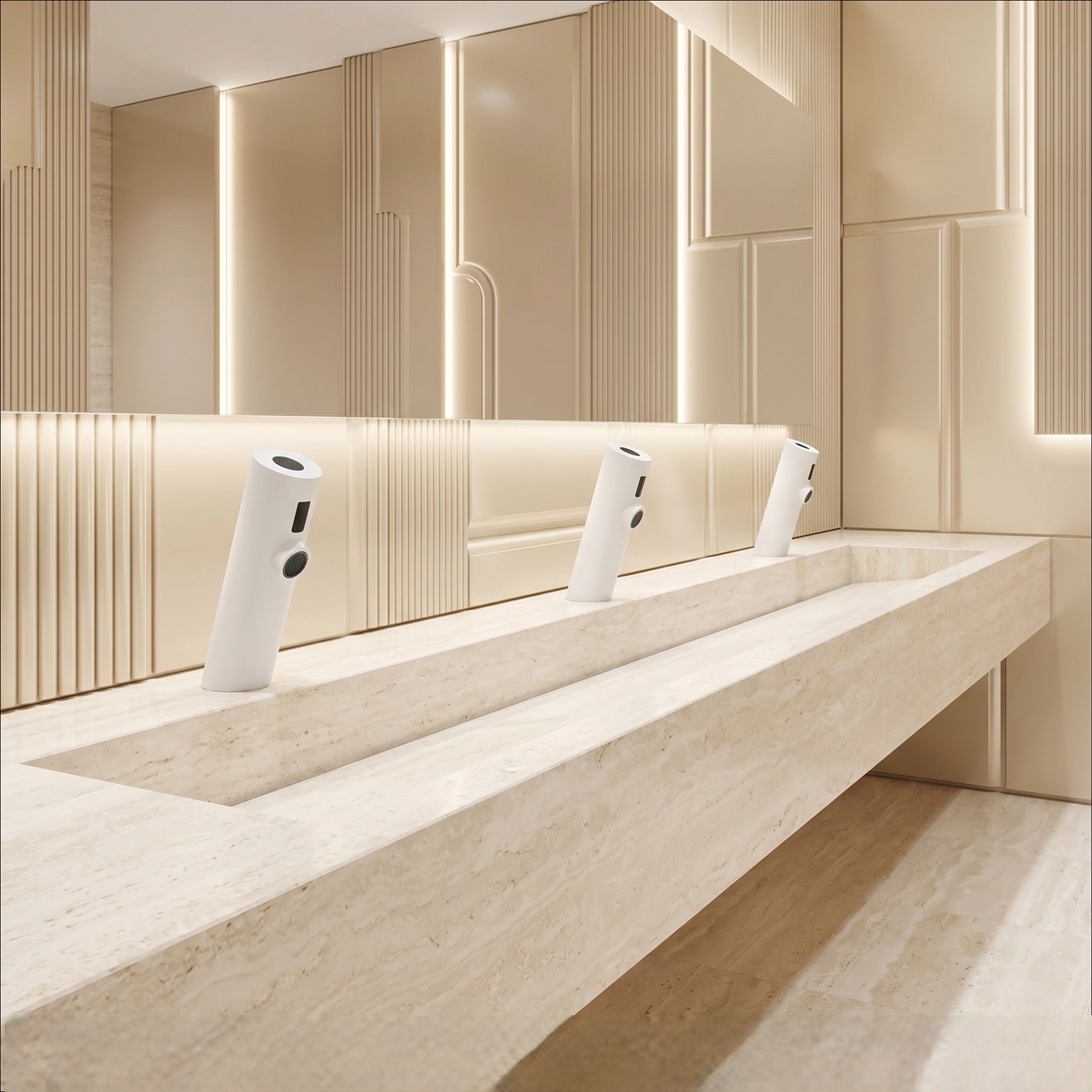
Design for the Peak, Not the Average
A large venue can appear adequately served during most of an event and still fail at halftime or intermission. The planning problem is therefore one of synchronized demand. Fixture counts, entrance geometry, exit paths and internal circulation need to be evaluated together because a bottleneck in any one of them can reduce the useful capacity of the whole room.
For a 50,000–100,000-seat stadium, the source material groups the engineering challenge into five priorities: peak throughput, plumbing capacity, touchless-system reliability, rapid maintenance and lifecycle operating cost.
Throughput Is a System Property
Long queues are not created by fixture count alone. Stall availability, urinal mix, washbasin capacity, dwell time, queue organization and the ability to enter and leave without crossing opposing flows all affect how quickly people can move through the space.
The same logic applies to women’s restroom queues. Nominally similar capacity does not guarantee similar throughput when actual dwell time and fixture mix differ.
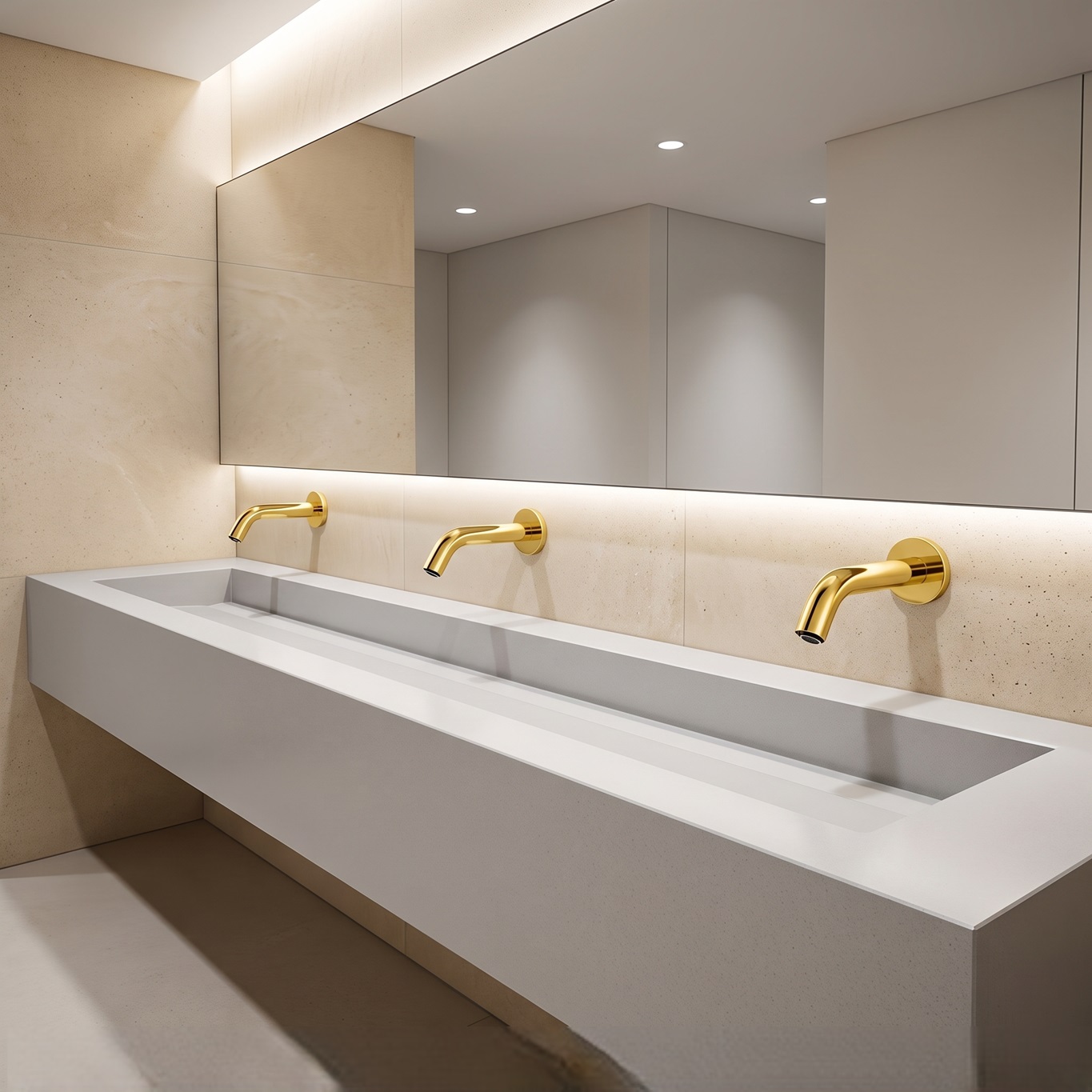
Simultaneous Plumbing Demand
During a break, dozens or hundreds of faucets and flush valves may operate close together in time. Poorly engineered plumbing can produce pressure drops, inconsistent flow, weak flushing and temperature instability exactly when reliability matters most.
A mega-venue restroom therefore needs to be evaluated as a simultaneous-load environment, not as a collection of isolated fixtures.
Soap, Water and Power at Scale
Small soap reservoirs become a labor and reliability problem when traffic is intense. Large-capacity or centralized soap strategies can reduce refill frequency and the chance that dispensers are empty during a demand spike.
Electronic fixtures also create a power architecture decision. Battery-only systems can impose a large replacement burden across hundreds of devices; carefully engineered AC or AC/DC approaches may reduce that burden depending on the facility.
| Design factor | What to evaluate | Why it matters |
|---|---|---|
| Peak throughput | Fixture mix, circulation, entrance/exit flow | Queue growth during predictable breaks |
| Plumbing capacity | Simultaneous flow and flush demand | Pressure drop and inconsistent performance |
| Touchless reliability | Sensors, power, activation logic | Failures multiplied across heavy traffic |
| Rapid maintenance | Service access and standard parts | Longer outages and labor burden |
| Lifecycle cost | Cleaning, consumables, repairs | High recurring operating expense |
Maintenance Between Demand Waves
Cleaning and service access need to be built into the architecture. Floors, counters, basins, toilets and urinals can deteriorate quickly when thousands of visitors cycle through in minutes, so the room should support rapid reset rather than simply look refined when empty.
Technicians also need practical access to cartridges, solenoids, sensors, batteries, valves and soap without shutting down an entire restroom bank.
Standardization and Lifecycle Cost
Using many incompatible faucet, sensor, valve, battery and dispenser platforms across one venue creates a spare-parts and training burden. Standardization can reduce maintenance complexity and simplify stocking.
The most successful restroom is not necessarily the one with the most premium fixtures. It is the one that can repeatedly absorb the peak without queues, failures, pressure problems, empty soap or excessive maintenance.
Read More: Why average-use planning fails
Expanded context
A stadium restroom can appear functional for most of an event and still be poorly designed. Average-use planning hides the short interval in which nearly every fixture and circulation path is tested simultaneously. Peak-demand planning asks whether the room can keep moving, stay supplied, maintain pressure and recover quickly when the demand wave passes.