Deck-Mounted vs. Wall-Mounted Commercial Touchless Faucets: Plumbing, Maintenance & AEC Planning Guide
Choosing between a deck-mounted and wall-mounted touchless faucet changes much more than restroom appearance. Mounting architecture influences plumbing rough-in, countertop fabrication, sensor position, maintenance access, basin coordination and future fixture replacement. Architects and MEP engineers should make this decision before millwork, wall assemblies and plumbing locations are finalized.
Deck Mount or Wall Mount?
Conventional Commercial Architecture
The faucet passes through the countertop, lavatory deck or fixture opening. Installation is familiar, replacement is generally straightforward, and many commercial basin systems are designed around this arrangement.
Architectural & Counter-Free Approach
The spout projects from the wall or service assembly, leaving the countertop visually cleaner. Plumbing and sensor geometry require earlier coordination because rough-in occurs behind the finished wall.
How the Two Architectures Compare
| Design Factor | Deck-Mounted | Wall-Mounted |
|---|---|---|
| Rough-in | Primarily below deck. | Requires coordinated wall plumbing. |
| Countertop | Requires faucet penetration. | Can leave deck uninterrupted. |
| Replacement | Usually easier to retrofit. | Replacement geometry requires closer coordination. |
| Cleaning | Faucet base creates another deck interface. | Open deck can simplify wiping around basin. |
| Sensor geometry | Closely tied to deck and basin relationship. | Spout projection and mounting height become critical. |
| Aesthetic | Traditional commercial configuration. | Architectural, floating appearance. |
Commercial Touchless Faucets Worth Reviewing
These examples demonstrate different mounting strategies. The product image and product title are both clickable to the corresponding product page.

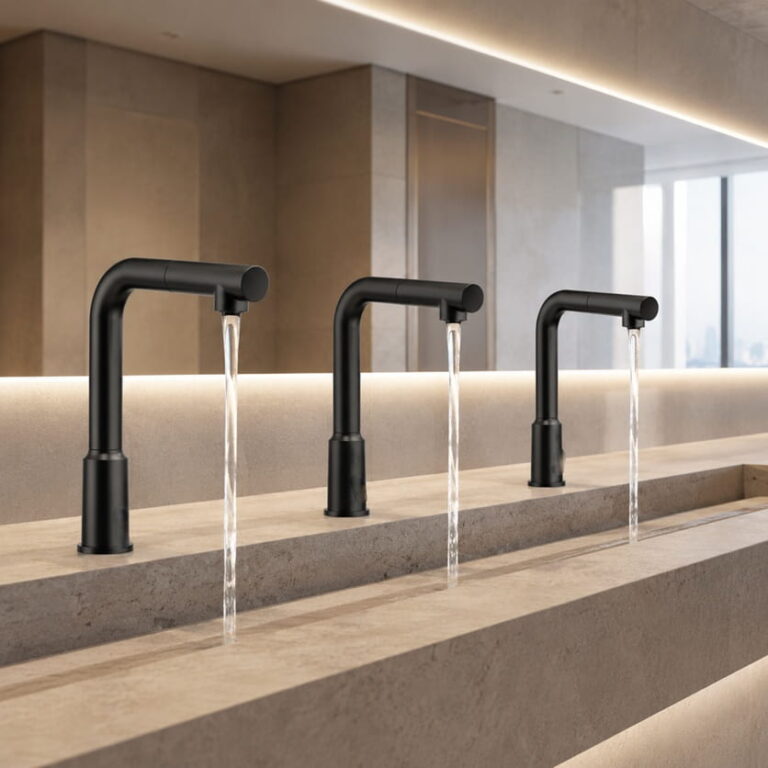
Fontana Brio Wall-Mount Commercial Sensor Faucet — Matte Black
The Fontana Brio Wall-Mount Commercial Sensor Faucet demonstrates how touchless technology can be integrated into a minimalist wall-mounted specification. Fontana describes regulated 0.35–0.5 GPM laminar flow together with infrared sensing and automatic shutoff logic.
From an architectural perspective, the wall-mounted arrangement removes the faucet body from the countertop and can support cleaner visual lines in luxury hospitality, executive offices and premium commercial washrooms.
Explore Fontana Brio →
Fontana Verona Chrome Deck-Mount Commercial Sensor Faucet
The Fontana Verona Deck-Mount Commercial Sensor Faucet represents the more conventional commercial installation strategy. Its deck-mounted configuration is well suited to projects where lavatory openings, countertop fabrication and below-deck service zones can be coordinated conventionally.
Fontana also provides specification, BIM, installation, maintenance and warranty resources, which makes the product useful during AEC documentation rather than only final fixture procurement.
Explore Fontana Verona →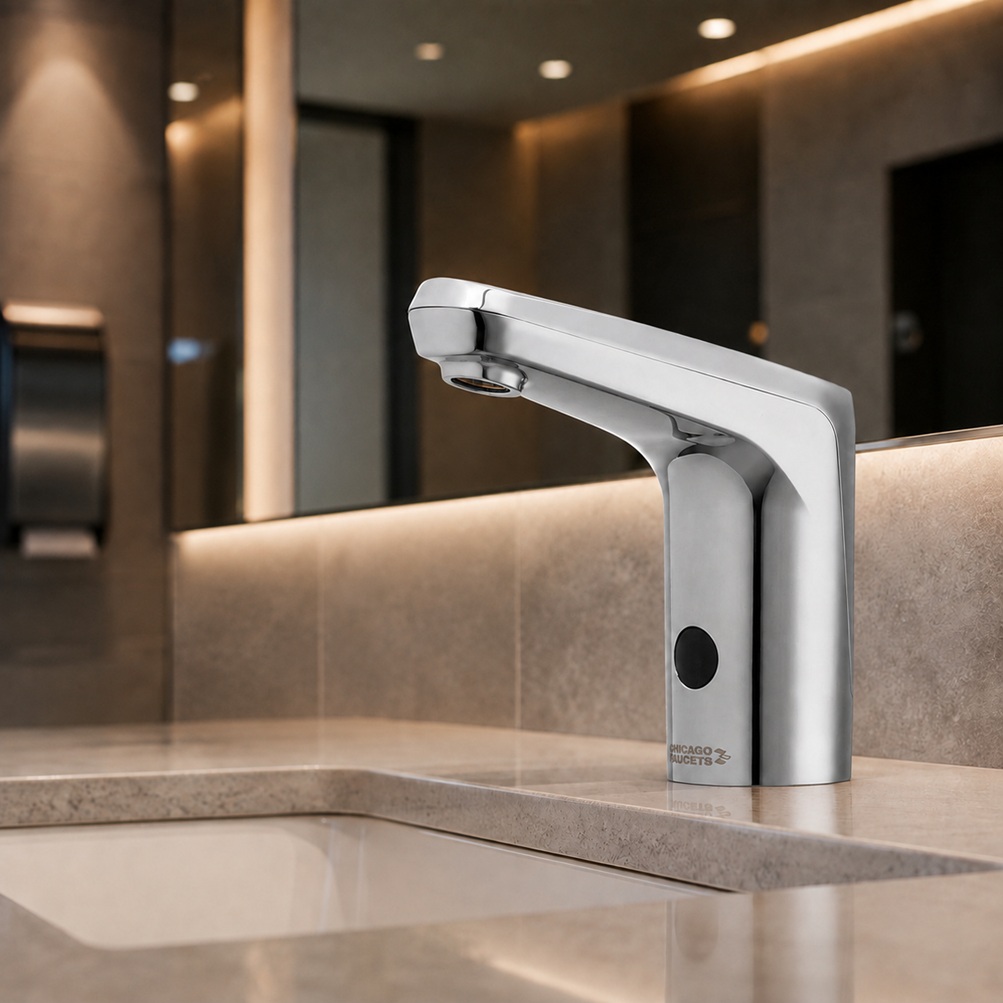
Zurn AquaSense® Gooseneck Smart Wall-Mount Sensor Faucet
Zurn’s Z6922 platform combines a wall-mounted gooseneck configuration with infrared proximity sensing and wireless usage monitoring. The manufacturer specifies a 0.5 GPM aerator and 60-second timeout.
This is a useful example for facility teams considering wall-mounted architecture together with connected maintenance and usage data.
Review Zurn AquaSense →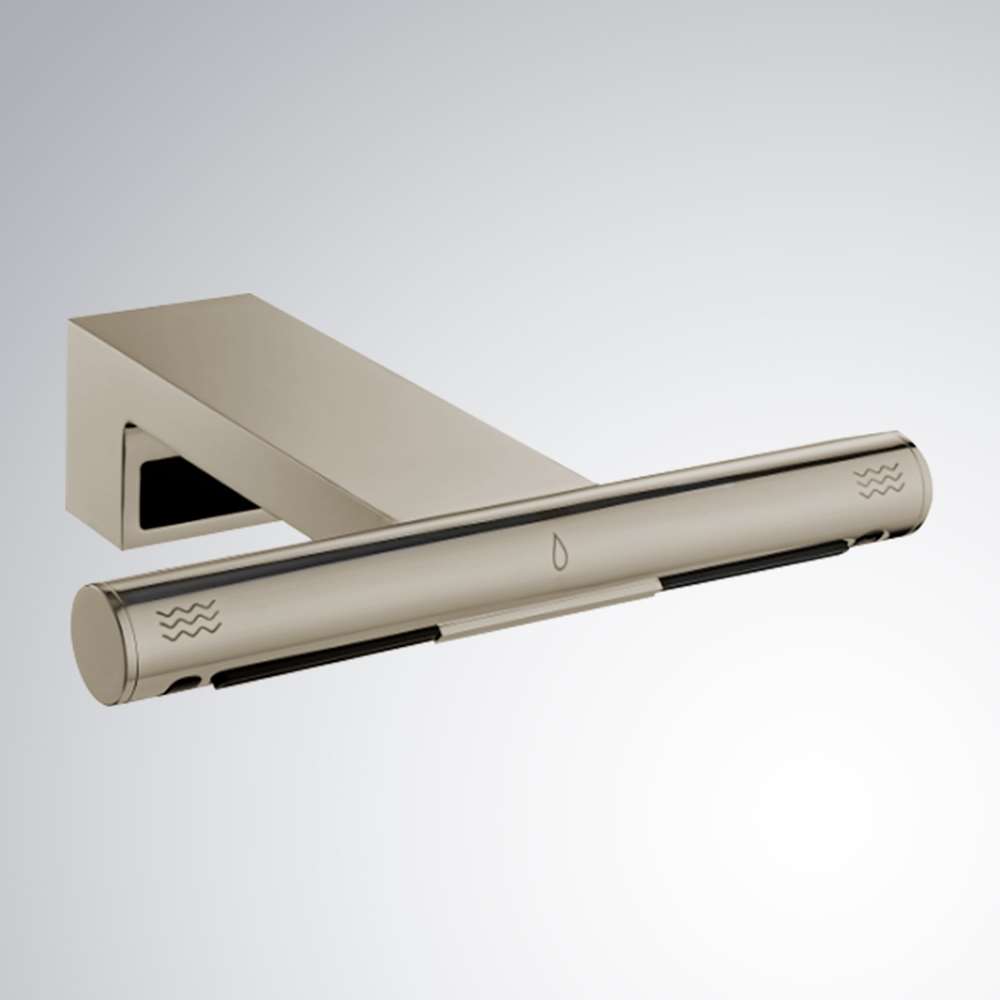
Fontana Vicenza Automatic Touchless Integrated Wall-Mount Sensor Faucet with High-Speed Hand Dryer
The Fontana Vicenza Integrated Wall-Mount System takes wall-mounted planning further by combining sensor-controlled water delivery and high-speed hand drying at the basin.
This architecture can reduce movement between sink and remote dryer while minimizing countertop equipment. It also requires earlier coordination because water delivery, electrical supply, airflow and service requirements converge into one handwashing station.
Explore Fontana Vicenza →Product policy: Products are displayed only when the identified faucet and usable product image can be matched. Generic substitute imagery is not intentionally used.
Rough-In Geometry Must Be Decided Early
A wall-mounted faucet requires the design team to coordinate mounting height, horizontal spout projection, basin centerline and water impact location. Moving the faucet after tile, stone or wall panels are installed can be significantly more disruptive than changing a conventional deck-mounted fitting.
Where Will the Technician Stand?
Deck-mounted faucets often place valves, batteries and connections below the counter. That can simplify initial construction while creating cramped maintenance access.
Wall-mounted systems can relocate components into a wall cavity or service zone. When properly planned, a dedicated access panel can provide excellent serviceability. When poorly planned, the same installation can require removal of architectural finishes.
The specification should therefore identify both where the faucet is mounted and where its serviceable components will remain accessible.
Mounting Style Does Not Replace ADA Review
ADA Standards Section 606 requires accessible lavatory coordination, including maximum lavatory height and appropriate knee/toe clearances. Faucet controls must comply with Section 309. Touchless activation can simplify operation, but basin geometry, reach and surrounding elements still require coordinated accessible design.
Commercial Faucet Brands Worth Researching
Deck vs. Wall-Mount FAQ
Which mounting style is easier to retrofit?
Deck-mounted faucets are generally easier when an existing compatible faucet opening and below-deck plumbing already exist.
Why choose a wall-mounted sensor faucet?
It can free countertop space, simplify deck cleaning and create a more architectural appearance.
What is the biggest wall-mount design risk?
Incorrect rough-in geometry. Mounting height and projection must coordinate precisely with the selected basin.
Are deck-mounted faucets easier to maintain?
Not always. Maintenance depends on where the control box, batteries, filters and valves are located and how technicians access them.
Does mounting style affect sensor performance?
It can. Sensor location relative to the basin and user’s hands changes with faucet geometry and should be evaluated during specification.
Can wall-mounted faucets work in high-traffic restrooms?
Yes. The important factors are commercial construction, appropriate sensing, service access, correct rough-in and basin coordination.
Professional References
U.S. Department of Justice — 2010 ADA Standards
Accessibility requirements covering lavatories, sinks and faucet controls.
U.S. EPA — Bathroom Faucet Efficiency
EPA guidance identifies 0.5 GPM or less as efficient for public lavatory faucets.
American Society of Plumbing Engineers
Professional plumbing engineering education and commercial system design resources.
U.S. Green Building Council — LEED
Green-building framework relevant to indoor water-use efficiency and commercial design.
Choose Mounting Architecture Before Finalizing the Lavatory
For conventional retrofits and straightforward service replacement, deck mounting often provides the simplest path. Wall-mounted touchless faucets can deliver cleaner counters and stronger architectural integration, but require earlier plumbing, basin and access coordination. The best solution is the one whose rough-in and maintenance strategy are designed intentionally—not discovered during installation.
Explore Fontana Brio Wall-Mount Sensor Faucet →Independent editorial disclosure: CommercialTouchlessFaucets.com provides engineering-oriented informational analysis. Verify current manufacturer drawings, installation requirements, certifications, plumbing codes and authority-having-jurisdiction requirements before specification or procurement.